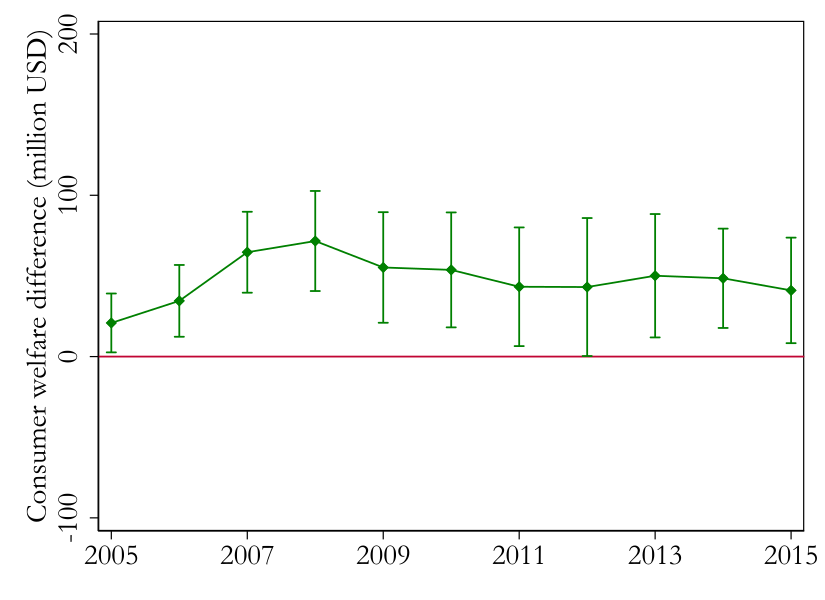
Current enforcement practice does not consider how mergers alter the
merging parties’ incentives to petition for trade protection. I document
mergers between domestic producers across jurisdictions that are
followed by tariff petitions. I develop a model to characterize the
trade-policy channel of mergers. Theoretically, a domestic merger raises
the profitability of tariffs when offshoring is unavailable; once
offshoring is possible, the effect becomes ambiguous. I apply this
framework to a merger between domestic producers in the U.S. appliance
industry. Empirically, I find that when import competition is weak, the
merging parties prefer to lower their own costs through offshoring; when
import competition is strong, the merger makes it more profitable for
them to raise their foreign rivals’ costs through tariffs. The resulting
consumer harm is comparable in magnitude to the direct market-power
effect. A hypothetical cross-border merger reduces the profitability of
tariffs in this market.
Mergers and the Demand for Protectionism
Felix Montag
NYU Stern,
CEPREmail:
felix.montag@nyu.edu. I thank Jonathan Elliott, Karam Kang, and Ali
Yurukoglu, as well as seminar participants at NYU, the Stigler Center,
the ITAM/UT Austin IO Conference, Georgetown University and the Yale
Trade Day for helpful comments and suggestions. This work was supported
in part through the NYU IT High Performance Computing resources,
services, and staff expertise.
This version: 2026-06-10
Introduction
Antitrust enforcement in most jurisdictions, including the European
Union and the United States, applies a consumer-welfare standard. This
standard is administered separately from trade policy, keeping antitrust
focused on consumer welfare and insulated from trade-policy
considerations (Bradford and Chilton 2021). As trade
costs fall, lowering costs through offshoring becomes more profitable
for domestic incumbents and increases their support for free trade. At
the same time, if domestic producers are subject to intense import
competition, domestic consolidation may raise their demand for
protectionism.
Antidumping (AD) and countervailing duty (CVD) petitions are the most
common ways domestic producers seek trade protection. The investigating
authority subjects imports to tariffs if it determines that they are
sold at less than fair value or subsidized by a foreign government, and
that the domestic industry is materially injured by those imports. The
mandate of the investigating authority can conflict with the competition
authority’s consumer-welfare
standard.Recognizing
this tension, in 2022 the U.S. Senate Subcommittee on Competition
Policy, Antitrust, and Consumer Rights asked the U.S. Government
Accountability Office to review AD/CVD processes and domestic market
competition considerations, particularly focusing on “how aspects of
market competition factor into the AD/CVD process” (U.S. Government Accountability
Office 2022). Despite this potential conflict, the
trade-policy implications of mergers remain unexamined in clearance
decisions. Across multiple jurisdictions, I identify high-profile
horizontal mergers between domestic producers followed by tariff
petitions. In many of the corresponding merger clearance decisions,
imports are mentioned as a competitive constraint on the merging
parties.
In this paper, I study how merger control affects domestic
incumbents’ incentives to petition for tariffs. I develop a framework to
estimate whether a proposed merger lowers or raises the profitability of
tariffs to the merging parties, and hence their propensity to file. I
apply this framework to the Whirlpool–Maytag merger in the U.S.
appliance industry, specifying and estimating a structural model of
demand and supply following Montag (2026), with which I quantify the
effect of the domestic merger across counterfactual production-location
scenarios. To examine the effect of cross-border mergers, I also
quantify how a hypothetical merger between Whirlpool and LG changes the
profitability of tariff petitions.
The paper’s central contribution is to identify and quantify a
trade-policy channel through which mergers between domestic producers
can harm consumers beyond direct market-power effects. Theoretically,
when offshoring is unavailable, a domestic merger strictly raises the
profitability of tariffs to the merging parties; when offshoring is
available, the sign becomes ambiguous. Empirically, I find that for the
Whirlpool–Maytag merger, offshoring is more profitable than petitioning
for tariffs in years when import competition is weak, while petitioning
becomes more profitable than offshoring in years when import competition
is strong. Even holding the likelihood of tariffs fixed, the merger
raises tariff-induced consumer harm by more than 10 percent; in total,
the consumer harm through the trade-policy channel is of the same order
of magnitude as the harm from unilateral market power. A hypothetical
cross-border merger reduces the profitability of tariffs in the same
market.
I specify a three-stage model to analyze the effect of mergers on the
incentives to petition for tariffs. In Stage 1, the competition
authority adjudicates a horizontal merger involving a domestic incumbent
that faces import competition. In Stage 2, given the competition
authority’s decision, the incumbent chooses among offshoring production
to lower marginal costs, petitioning for tariffs to raise foreign
rivals’ costs, or maintaining the status
quo.Igami (2018) studies the
relationship between import competition and offshoring in the Hard Disk
Drive Industry, showing that offshoring is pro-competitive and benefits
consumers. Stage 3 embeds a differentiated-demand,
oligopolistic-supply model in which firms set prices and consumers
choose products.
Most directly, the paper relates to a literature concerned with the
stringency of merger control. Nocke and Whinston (2022) show that
current concentration thresholds are too lax in the absence of large
efficiency gains. Retrospective analyses of consummated mergers found
mixed results (Ashenfelter et
al. 2013; Kwoka 2015; Bhattacharya et al. forthcoming). Asker and Nocke (2021)
and Shapiro and
Yurukoglu (2026) review this literature and conclude that the
estimated price effects vary widely and that the evidence is mixed.
Breinlich et al.
(2018) study optimal merger policy for international mergers in
settings where multiple national agencies can block a transaction across
jurisdictions.Horn and Levinsohn (2001)
and De Stefano and
Rysman (2010) develop models in which a country chooses the level
of domestic concentration through merger policy and show that when firms
are exporters, national authorities may prefer a level of concentration
that is excessive from a global perspective.Montag (2026) extends
the scope of merger analysis by studying how the Whirlpool–Maytag merger
affects total domestic welfare (consumers and workers) when potential
acquirers for Maytag differ in their offshoring plans.
I extend this literature by identifying a channel through which
mergers affect consumers via trade policy: by changing the merging
parties’ incentives to raise rivals’ costs through tariff
petitions.Salop et al. (1984)
discuss how tariffs can be used to raise the cost of rivals.
Furthermore, I provide a quantitative framework that allows competition
authorities to assess how a merger changes the profitability of tariffs
for the merging parties and the resulting consumer harm. I show that
imports impose weaker competitive discipline on a merged domestic
incumbent than equivalent domestic rivals would: because imports can be
restricted through trade remedies but domestic rivals cannot, the
discipline-from-imports defense for merger clearance can be weaker than
it
appears.This
limits the widely held presumption, formally examined by Neven and Seabright
(1997), that trade liberalization can substitute for domestic
competition policy. The stronger the competitive constraint from
imports, the stronger the incentive to petition for trade remedies.
Merger control should therefore discount the competitive constraint from
imports when this can be restricted post-merger.
The paper also contributes to a literature on market structure and
lobbying. Classic political-economy models predict that organized
sectors obtain protection (Grossman and Helpman 1994;
Goldberg and Maggi 1999), and firm size predicts participation
and intensity (Bombardini 2008). Kang (2016) finds that
while lobbying has a small effect on policy enactment, the returns to
lobbying are high. Recent evidence indicates that consolidation raises
lobbying across (Cowgill
et al. 2024) and within industries (Moshary and Slattery 2024).
I contribute to this literature in two ways. First, I extend it
beyond traditional political lobbying. AD/CVD petitions are a
quasi-judicial channel, relatively insulated from direct political
bargaining, that present incumbents with a distinct choice set
(petition, offshore, or maintain the status quo). I show that mergers
between domestic producers raise the profitability of tariffs for the
merging parties. Second, I decompose the merger effect into two
channels: the appropriation effect (the acquirer internalizes
the benefits of tariffs to the target) and the strategic effect
(the tariff raises the profit of the merged firm by more than the sum of
standalone
profits).While
domestic producers could overcome the collective-action problem by
petitioning together, in practice, they often do not. Bombardini and Trebbi
(2012) find that firms in more concentrated industries are more
likely to lobby on trade issues individually rather than through a trade
association. Distinguishing them matters because the two channels
respond differently to the merger structure.
A related literature studies how AD/CVD cases can raise market power
(Nieberding
1999; Konings and Vandenbussche 2005; Pierce 2011; Rovegno 2013)
and facilitate collusion (Staiger and Wolak 1989). Because
dumping margins depend on foreign pricing, the option value of a
petition can induce higher foreign prices even before a case is filed.
Blonigen et al.
(2013) find that binding quotas increased market power in the
U.S. steel industry, whereas tariffs did not, which is consistent with
strong domestic competition from minimill producers disciplining
outcomes. Flaaen et al.
(2020) show that the initial AD/CVD actions on large residential
washers primarily induced tariff jumping, whereas the 2018 global
safeguards raised U.S. washer prices.
I extend this literature to show that when there are few domestic
competitors, tariffs can generate substantial consumer harm. Whereas the
literature focuses on how protection changes competition, I focus on how
mergers alter the likelihood and harm from tariffs.
The Draghi
(2024) report argues that European economic growth requires scale
economies, prompting calls to relax EU merger
control.Even
earlier, France and Germany urged approval of the Siemens/Alstom merger
to create a “European champion” in rail equipment; the European
Commission nonetheless blocked the transaction in 2019. The
European Commission’s April 2026 Draft Merger Guidelines also emphasize
the enablement of scale economies. My results do not imply that merger
control should be tightened across the board. Instead, mergers between
domestic firms facing strong import competition should be scrutinized
more closely; cross-border consolidation, by contrast, can deliver scale
economies without raising incumbents’ returns to tariff petitions.
The remainder is structured as follows: Section 2 reviews measures to protect against
import competition and their relation to merger control, Section 3 specifies the model, Section 4 describes the appliance industry,
Section 5 details the empirical model and
estimation, Section 6 presents the parameter estimates,
Section 7 simulates counterfactuals, and
Section 8 concludes.
Trade Protection and Merger Control
AD and CVD measures are the most commonly used trade-defense
instruments worldwide. Since these are grounded in World Trade
Organization (WTO) rules, the criteria and procedures for AD/CVD are
codified in WTO agreements and apply across WTO members. Global
safeguards (GS) are also WTO-authorized but used much less frequently.
While the following discussion focuses on the institutional
implementation in the United States, it should be understood as applying
to other jurisdictions as well.
In the United States, the most commonly used alternative
trade-defense tools are Section 232 actions (national security-based
trade measures) and Section 301 actions (retaliatory trade measures). In
the U.S., AD/CVD measures accounted for 97 percent of all trade actions
initiated between 2002 and 2024 and in 2022 resulted in tariffs covering
$37.4 billion of imports (Liu 2026). AD/CVD almost always originate
from a petition filed by a domestic stakeholder. In contrast,
Section 232 and Section 301 actions are initiated by the government and
are not grounded in WTO authorized procedures. Based on interviews with
practitioners, Liu
(2026) reports that AD/CVD petitions remain the first tool of
choice for domestic producers seeking protection from import
competition.
AD duties are imposed on imports that are determined to be sold at
less than fair value and that materially injure a domestic industry.
Selling at less than fair value typically refers to a situation in which
a firm sells a product at a lower price in the importing country than in
its home market (Blonigen and Prusa 2016). If the
exporter’s home market is deemed unsuitable for comparison, its sales
price in a third country may be used instead. Since products destined
for home and export markets often differ, defining the foreign-like
product affords the Department of Commerce considerable leeway in AD
cases. An alternative standard used in many AD cases is sales below
cost. Although allocating fixed costs to products is notoriously
difficult and standard economic theory shows that firms may rationally
sell below average total cost (but above average variable cost), a price
below average total cost is considered
dumping.Blonigen and Prusa
(2016) explain that although the U.S. Antidumping Act of 1916 was
originally designed to protect domestic producers from predatory
pricing, the required predatory intent was soon dropped from the law,
and it has since become an ordinary protection tool.
While the U.S. International Trade Commission (USITC) may solicit
downstream purchaser information during its investigations, AD/CVD laws
do not allow the USITC to consider the economic effects of exporters’
behavior on downstream purchasers or on the national interest (U.S. Government Accountability
Office 2022). In practice, the Department of Commerce determines
whether the product is sold at less than fair value, and the USITC
determines whether a domestic industry is materially injured by reason
of the imports. In making the injury determination, the USITC cannot
take into account any potential harm that AD/CVD duties may impose on
downstream industries or consumers. This constraint lies at the core of
the tension between trade law and competition law. While federal
agencies, including the Department of Justice (DOJ) and the Federal
Trade Commission (FTC), can submit statements of interest in AD/CVD
cases, the DOJ has done so only once and promptly withdrew its
statement. No other federal agency has submitted a statement in recent
decades (U.S. Government
Accountability Office 2022). WTO rules do not impose this
constraint. Australia, Brazil, Canada, and the European Union all have
some form of public-interest provisions that can lower or eliminate
duties if doing so benefits downstream users.
AD is popular among domestic petitioners for several reasons. First,
AD is a particularly effective instrument against import competition
because it discourages exporters from competing aggressively: the lower
the exporter’s price, the more likely a domestic rival can establish
that the product is sold at less than fair value. Since the tariff rate
increases with the exporter’s productivity, Ruhl (2014) shows that AD is particularly
distortionary. Second, investigations last at most 18 months and the
clear criteria and quasi-judicial framework make them predictable and
more insulated from political interference (Blonigen and Prusa 2016). Third, while
AD duties require periodic review, many remain in effect for
decades.
CVD measures address cases in which imports are found to benefit from
foreign subsidies. As with AD, the imports must materially injure, or
threaten to materially injure, a domestic industry. Although the trade
practices targeted by AD and CVD differ, the procedures and underlying
concerns are often similar, and petitioners frequently seek protection
under both measures simultaneously (Liu 2026).
Unlike AD/CVD, global safeguards can be imposed on fairly traded
imports from all countries if a domestic industry is found to be
seriously injured by a surge in imports; they do not require evidence of
dumping or foreign subsidization. In the U.S., they are imposed at the
discretion of the President for an initial duration of up to four years.
They are therefore also more subject to the political process.
AD/CVD petitions occur frequently. According to data compiled by
Bown et al. (2025),
between 1980 and 2024 the EU initiated 440 AD, 77 CVD, and 7 GS
investigations, while India initiated 517, 24, and 48, respectively.
U.S. authorities initiated 747 AD, 453 CVD, and 15 GS investigations
during the same time period. Between 2011 and 2021, 74 percent of AD/CVD
petitions in the U.S. resulted in orders (U.S. Government Accountability Office
2022). At the same time, preparing a petition is costly,
requiring legal counsel, expert economic analysis, participation in
administrative hearings, as well as periodic sunset reviews.
Practitioners interviewed by Liu (2026) estimate that the cost of a
simple AD/CVD petition ranges between $1 million and $3 million, and can
be substantially higher for complex cases involving multiple products or
origin countries.
Petitions for trade remedies are typically initiated by domestic
firms or industry associations that claim injury from foreign
competition. Liu
(2026) reports 789 petitioner appearances in AD/CVD cases between
2002 and 2024, representing 528 unique entities. Of these, 14 were labor
unions, 217 were trade associations or coalitions, and the remaining 297
(56%) were individual domestic producers. In many cases, only a subset
of domestic producers participate in a petition. Although 55 percent of
petitioners are connected to the steel or chemicals industries,
petitions arise in many tradable-goods sectors.
While any domestic producer may petition for trade remedies, smaller
producers often cannot meet the statutory industry-support thresholds
required for filing and therefore cannot petition alone. According to
the WTO Antidumping Agreement’s industry-support thresholds, a petition
is deemed “on behalf of the industry” if its supporters account for at
least 25 percent of total domestic production of the domestic like
product and more than 50 percent of the production of those expressing a
view. When these thresholds are met, Commerce may initiate without
polling producers, thereby reducing procedural frictions and the risk of
standing challenges (United States
Code 2025b, 2025a; Code of Federal Regulations 2025; U.S. International
Trade Commission 2015).
To understand whether mergers are associated with trade-remedy
petitions, I assemble a non-representative sample of nine horizontal
mergers affecting 16 antitrust markets, where the merging parties have
domestic production capacity in the relevant antitrust markets and where
AD/CVD petitions were filed in at least one antitrust market within five
years
post-merger.The
mergers span aluminium extrusions in Australia; thermoplastic resins in
Brazil; oil country tubular goods in Canada and the United States;
continuous filament glass fibre, stainless steel, and graphic paper in
the European Union; flat-rolled carbon steel in India; and appliances in
the United States.
A more systematic descriptive analysis is constrained by data
availability. While data on AD/CVD petitions is publicly available and
aggregated by Bown et al.
(2025), information about market shares and the number of
domestic producers at the antitrust-market level is generally not
disclosed. For mergers that competition authorities scrutinize more
heavily, redacted versions of this information sometimes appear in the
published
decisions.This
is especially true for the European Commission, which publishes detailed
merger decisions that include lengthy discussions of market definition
for Phase II merger investigations. Crucially, the same
producer-share information is not available for the “control markets”
needed to construct a comparison
group.Section 4.3 takes an alternative approach,
exploiting variation across U.S. appliance markets where some experience
a fall in the number of domestic producers and others do not.
In many of these cases, the clearance decision explicitly cites
import competition as a competitive constraint on the merging parties.
Two of the sample cases illustrate the pattern. In its Owens Corning
/ Saint Gobain Vetrotex conditional approval, the European
Commission cites customer reports claiming that imports are a viable
alternative to domestic producers for certain types of rovings (European
Commission 2007). Two years after the merger, a group of domestic
producers, including Owens Corning, filed an AD petition on continuous
glass fibre from China, which includes rovings. In the United States,
the DOJ cleared the Whirlpool–Maytag merger on the grounds that foreign
manufacturers posed a sufficiently large competitive constraint to
prevent post-merger price increases (Department of Justice 2006). Once these
foreign manufacturers gained significant market shares, Whirlpool filed
for AD and CVD on large residential washers from Korea and Mexico.
While AD/CVD are sometimes discussed in merger cases, this is usually
in the context of how they shape the competitive environment. For
example, in its ArcelorMittal / Ilva decision, the European
Commission writes “As the trade defence measures on certain [...]
products cover some of the major steel producing and steel exporting
countries, any assessment of the extent to which imports of HR, CR and
HDG products may exert competitive pressure on EEA-based flat carbon
steel producers and, in particular the merged entity post-Transaction,
must be made in light of the situation as restored by anti-dumping
duties” (European Commission 2018,
56). The Commission thus treats the trade-defense environment as
an exogenous input to merger analysis, rather than considering how the
merger itself may alter the incentives to petition for new measures.
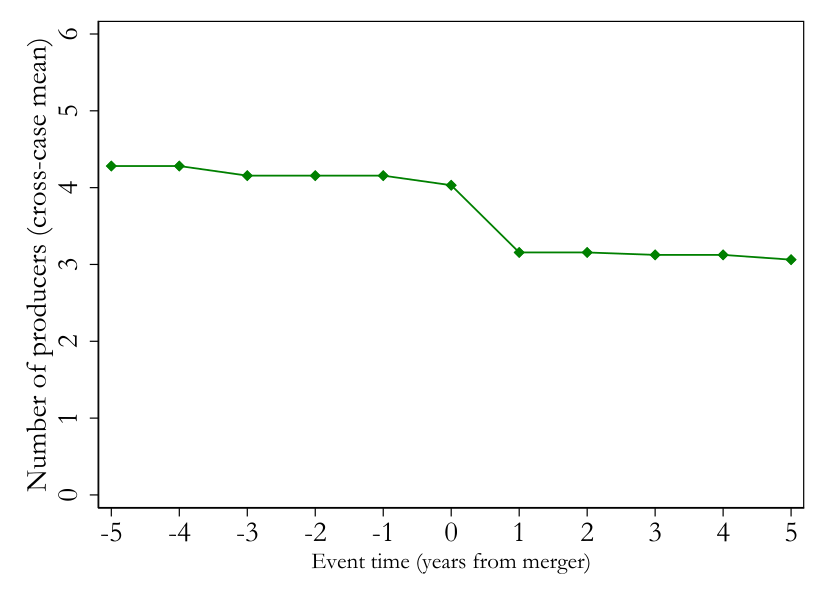
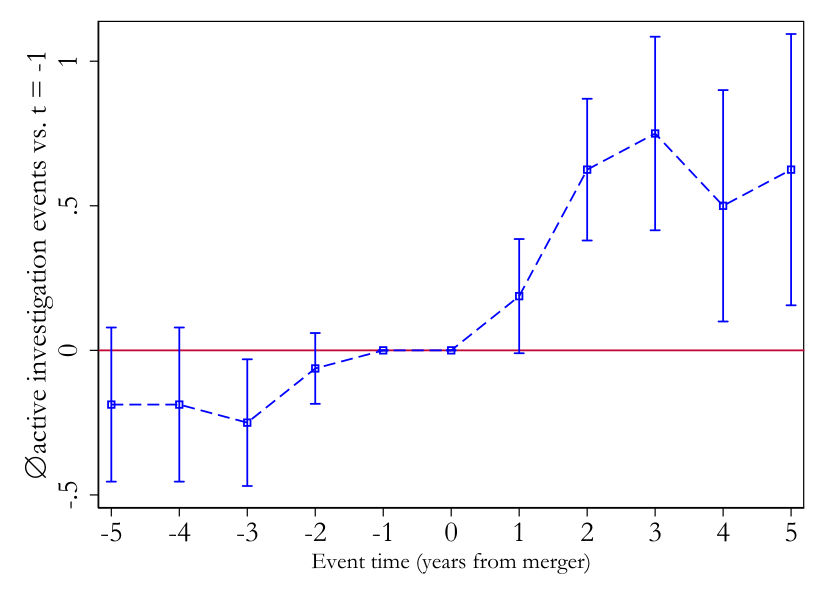
Figure 1 plots the number of
domestic producers that together account for at least \(80\%\) of domestic production (\(n^{80}_{jt}\)), as well as the average
within-market deviation of the number of active AD/CVD cases from its
pre-merger (\(t=-1\)) baseline, for the
nine horizontal mergers across 16
markets.Appendix 9 reports the per-case
concentration changes, restriction counts, and source
documentation. It shows that while the cross-case mean number of
major domestic producers decreases post-merger, the count of active
AD/CVD investigations increases.
A. Domestic concentration (\(n^{80}\))
B. AD/CVD restrictions
Notes: Panel A. Cross-case-product mean of \(n^{80}_{jt}\), the number of domestic
producers accounting for at least 80% of domestic production in the
affected product market in a particular year. Panel B.
Cross-case-product mean of the within-market deviation of the
active-restriction count in a particular year from its \(t = -1\) baseline. Whiskers show 95% CIs.
Mergers occur at \(t=0\).
Figure 1: Concentration and AD/CVD
restrictions around domestic mergers
Although this relationship is purely descriptive and could be caused
by other market trends affecting concentration and AD/CVD petitions, it
shows that in some mergers that are heavily scrutinized by antitrust
authorities, increases in domestic production concentration are followed
by increases in trade-remedy petitions.
In summary, AD/CVD cases are pervasive across the economy. The
administrative structure of the process makes petition outcomes
predictable, and success rates are higher when the foreign competitor
prices aggressively. Petitions are costly and are often filed by a
single domestic firm. Filing a petition therefore requires the
petitioner to expect sufficiently large increases in profits to offset
the cost of petitioning. Finally, mergers between domestic producers are
sometimes followed by trade-remedy petitions. The remainder of the paper
develops a model of merger-induced petitioning informed by these facts,
estimates it on the Whirlpool–Maytag case, and quantifies the resulting
consumer-welfare consequences.
Stylized Model
I specify a stylized model illustrating the link between mergers and
the demand for protectionism.
Setup
Consider a market with three firms. Firm 1 is a domestically
producing incumbent, firm 2 is a domestic acquisition target, and firm 3
is a foreign rival. Each firm produces a single, horizontally
differentiated product and sells exclusively in the domestic market.
Demand is generated by a unit mass of consumers with heterogeneous
preferences following a standard logit specification.
Each consumer derives utility from purchasing a single product or an
outside good. Products differ in product-specific deterministic utility
\(\delta_j\). The utility that a
consumer obtains from product \(j \in
\{1,2,3\}\) and from the outside option is \[\begin{equation}
\tag{1}
U_j = \delta_j - \alpha p_j + \varepsilon_j,
\qquad
U_0 = \varepsilon_0,
\label{eq:sty_utility}
\end{equation}\] where \(p_j\)
denotes the price of product \(j\),
\(\alpha > 0\) governs price
sensitivity, and \(\varepsilon_j,\varepsilon_0\) are
i.i.d. Type I extreme value.
Marginal cost depends on the location of production. Marginal cost is
\(c_D\) for domestic production and
\(c_F\) for foreign production, with
\(c_D>c_F\). Initially, firms 1 and
2 produce domestically at \(c_D\), and
firm 3 produces abroad at \(c_F\).
Relocation is a firm-level decision: firm \(f\) can relocate all of its production at a
fixed cost \(R_f>0\), paid once
regardless of the number of products it relocates. \(R_2\) is assumed to be high enough such
that firm 2 never relocates; \(R_1\) is
finite. If firm 1 acquires firm 2, it controls both products and, paying
\(R_1\) once, may relocate any
subset.
Firm 1 may petition for tariffs on all imports at petitioning cost
\(L>0\). If filed, the tariff is
imposed with certainty. The level of the ad valorem tariff \(\kappa>0\) is exogenously determined by
the trade commission and scales foreign marginal costs to \((1+\kappa)c_F\).
Stage 1: merger control
The domestic incumbent (firm 1) proposes a horizontal merger; let
\(\mathcal{M}\) denote the proposed
configuration. The competition authority (CA) applies a policy rule to
decide whether to clear or challenge. The CA’s baseline rule clears the
merger whenever the predicted change in consumer surplus from unilateral
market-power effects, \(\Delta^{MP}
CS(\mathcal{M})\), exceeds a policy threshold \(\bar{\Delta}\le 0\), the largest tolerated
reduction in consumer surplus: \[\begin{equation}
\tag{2}
\Delta^{MP} CS(\mathcal{M}) \;\ge\; \bar{\Delta}.
\label{eq:ca_rule}
\end{equation}\] In settings where horizontal mergers can alter
firms’ demand for trade protection, which translates into consumer
surplus through tariffs and prices, there is an additional trade-policy
channel of consumer surplus change, \(\Delta^{TP} CS(\mathcal{M})\), computed
from the equilibrium petitioning, offshoring, and pricing decisions
specified in Stages 2 and 3 below. If the CA evaluates mergers on
consumer welfare regardless of channel, it should apply the threshold to
the total effect, \(\Delta^{MP}
CS(\mathcal{M}) + \Delta^{TP} CS(\mathcal{M})\).
Stage 2: petitioning and
offshoring
Following the merger control decision, firm 1 decides whether to
offshore production, petition for tariffs, or maintain its current
production structure without petitioning. It chooses the option that
maximizes static profits net of fixed costs. Firm 1 never optimally
chooses to petition and offshore, because petitioning while offshoring
would raise firm 1’s own costs through the tariff.
If the merger is cleared, firm 1 prices products 1 and 2 jointly and
internalizes relocation and tariff effects across both products. If the
merger is blocked, firm 2 remains a separate domestic single-product
firm with cost \(c_D\) and never
relocates (since \(R_2\) is
sufficiently high).
Stage 3: pricing and demand
In the third stage, firms simultaneously choose prices in a
Bertrand-Nash equilibrium and consumers make discrete purchase
decisions.
Let \(s_j(\mathbf{p})\) denote the
logit market share of product \(j\)
implied by the utility specification above; \(s_0(\mathbf{p})\) is the outside share.
Given realized marginal costs \(c_j \in
\{c_D,c_F,(1+\kappa)c_F\}\) from Stage 2, each firm \(f\) chooses prices to maximize \(\sum_{j\in
\mathcal{J}_f}(p_j-c_j)s_j(\mathbf{p})\), where \(\mathcal{J}_f\) is the firm’s product set.
For a single-product firm \(j\), the
standard logit FOC gives \[\begin{equation}
\tag{3}
p_j=c_j+\frac{1}{\alpha(1-s_j)}.
\label{eq:sty_foc}
\end{equation}\] If firm 1 is multiproduct post-merger, prices
solve the following system of first-order conditions \[\begin{equation}
\tag{4}
\mathbf{p}=\mathbf{c}-\left(\frac{\partial \mathbf{s}}{\partial
\mathbf{p}}\circ\Omega\right)^{-1}\mathbf{s}(\mathbf{p}),\qquad
\frac{\partial s_j}{\partial p_k}=\begin{cases}
-\alpha s_j (1-s_j),& j=k,\\
\alpha s_j s_k,& j\neq k,
\end{cases}
\label{eq:sty_pricing}
\end{equation}\] where \(\mathbf{p}\), \(\mathbf{c}\), and \(\mathbf{s}(\mathbf{p})\) are the stacked
vectors of prices, costs, and shares, \(\partial \mathbf{s}/\partial \mathbf{p}\)
is the matrix of own- and cross-price share derivatives, \(\Omega\) is the ownership matrix with \(\Omega_{jk}=1\) if the same firm owns
products \(j\) and \(k\), and \(\circ\) denotes the Hadamard (element-wise)
product.
The consumer surplus change between two equilibria is the
compensating variation (Small and Rosen 1981): \[\begin{equation}
\tag{5}
\Delta
CS=\frac{1}{\alpha}\Big[\log\big(1+\textstyle\sum_{j}\exp(\delta_j-\alpha
p_j^{\text{after}})\big)-\log\big(1+\textstyle\sum_{j}\exp(\delta_j-\alpha
p_j^{\text{before}})\big)\Big].
\label{eq:sty_cs}
\end{equation}\]
Mergers, offshoring,
and trade protection
I now analyze the firms’ strategic choices in light of the merger
decision and the availability of trade-policy instruments. I focus on
how a merger between firms 1 and 2 affects firm 1’s incentive to
offshore production versus petition for trade protection, and how these
choices interact with market structure and consumer welfare. Proofs can
be found in Appendix 10.
Let \(\pi^{r}_{f,\mathcal{C}}\)
denote firm \(f\)’s variable profit in
regime \(r \in
\{\text{off},\text{pet},\text{sq}\}\) chosen by firm 1, under
merger configuration \(\mathcal{C} \in
\{\mathcal{S},\mathcal{M}\}\). \(\Pi^{r}_{f,\mathcal{C}}\) denotes total
profit, net of the relevant fixed cost. When the merger is cleared, firm
1 owns products 1 and 2; when blocked, it owns only product 1. For the
merged entity I drop the firm subscript and write \(\pi^{r}_{\mathcal{M}}\) and \(\Pi^{r}_{\mathcal{M}}\).
Proposition 1. Assume offshoring is more
profitable than petitioning at \(\kappa=0\), and petitioning is more
profitable than offshoring at some \(\hat{\kappa}>0\). Then there exists a
unique cutoff \(\kappa^* \in
(0,\hat{\kappa})\) such that firm 1 prefers petitioning over
offshoring iff \(\kappa>\kappa^*\).
A higher tariff raises foreign costs only, shifts shares toward firm
1, and increases its markups; offshoring leaves foreign costs unchanged
and lowers firm 1’s own costs. There is a unique \(\kappa^*\) at which firm 1 is indifferent,
above which it petitions and below which it offshores. The petitioning
payoff is monotonically increasing in \(\kappa\) while the offshoring payoff is
independent of \(\kappa\), giving a
unique crossing \(\kappa^*\).
To see how this threshold \(\kappa^*\) evolves with the competitiveness
of the foreign rival, comparative statics of \(\kappa^*\) in \(\delta_3\) are most transparent in a
two-product reduction (firms 1 and 3 only).
Proposition 2. In a two-product reduction
(eliminate firm 2 and product 2), the comparative static \(d\kappa^*/d\delta_3\) has no fixed sign:
depending on the remaining primitives, the indifference cutoff \(\kappa^*(\delta_3)\) can rise or fall as
the foreign product becomes more attractive.
As \(\delta_3\) rises, the foreign
product becomes more appealing. The relative effect on firm 1’s profits
differs by regime. Under petitioning, the tariff has two opposing
effects: by handicapping the foreign rival it shrinks the rival’s share
and insulates firm 1, but by making firm 1 the dominant domestic
producer it widens firm 1’s markup and leaves more profit exposed to a
more appealing rival. When the duty is large enough to nearly eliminate
the rival, the first effect dominates and petitioning insulates firm 1
more than offshoring, so \(\kappa^*(\delta_3)\) falls; when the
foreign rival remains strong even under the duty, the second effect
dominates and offshoring insulates more, so \(\kappa^*(\delta_3)\)
rises.This
is not true for any demand system. Under CES demand with monopolistic
competition (where each firm takes the price index as given), markups
are constant and the price of firm 1 does not react to the quality of
product 3. In a finite-firm CES oligopoly, markups depend on market
shares and some strategic interaction is restored, but it remains weaker
than under logit demand.
I first compare firm 1’s gain from petitioning for a given \(\kappa\), with and without the merger,
against a status-quo baseline.
Proposition 3. Let \[\begin{equation}
\tag{6}
\Delta^{\text{pet}}_{1,\mathcal{M}}\;\equiv\;\Pi^{\text{pet}}_{\mathcal{M}}\;-\;\Pi^{\text{sq}}_{\mathcal{M}},
\qquad
\Delta^{\text{pet}}_{1,\mathcal{S}}\;\equiv\;\Pi^{\text{pet}}_{1,\mathcal{S}}\;-\;\Pi^{\text{sq}}_{1,\mathcal{S}},
\label{eq:premium_sq}
\end{equation}\] be firm 1’s petitioning premium with and without
the merger. Then the merger’s impact admits the exact decomposition
\[\begin{equation}
\tag{7}
\Delta^{\text{pet}}_{1,\mathcal{M}}-\Delta^{\text{pet}}_{1,\mathcal{S}}
=\underbrace{\big(\pi^{\text{pet}}_{2,\mathcal{S}}-\pi^{\text{sq}}_{2,\mathcal{S}}\big)}_{\text{\emph{appropriation}}}
+\underbrace{\Big[(\pi^{\text{pet}}_{\mathcal{M}}-\pi^{\text{sq}}_{\mathcal{M}})
-(\pi^{\text{pet}}_{1,\mathcal{S}}+\pi^{\text{pet}}_{2,\mathcal{S}}-\pi^{\text{sq}}_{1,\mathcal{S}}-\pi^{\text{sq}}_{2,\mathcal{S}})\Big]}_{\text{\emph{strategic}}}.
\label{eq:decomp_sq}
\end{equation}\] Both the appropriation and the strategic effect
are strictly positive, so the merger strictly increases firm 1’s gains
from tariffs.
The appropriation effect captures the fact that the merger
internalizes a petitioning externality: firm 1 can now appropriate the
rents from tariff protection that would otherwise accrue to firm 2. The
strategic effect captures the fact that the merger raises how much firms
1 and 2 jointly gain from tariffs. Intuitively, the merged firm has
already internalized domestic competition, so the foreign rival
constitutes a proportionally larger part of its competitive environment;
weakening the foreign firm via the tariff therefore benefits the merged
entity more than the standalone firms. The aggregative-games framework
of Nocke and
Schutz (2018, 2025) underpins this result.
While I rely on logit demand, the result that the merger increases
firm 1’s gains from tariffs is true under mild assumptions on demand
(downward-sloping demand, substitutability across products, and standard
regularity conditions). In particular, while the strategic effect is
zero under CES demand with monopolistic competition, the appropriation
effect, and thus the overall effect, remain positive.
Next, I switch the baseline from status quo to offshoring.
Proposition 4. Let \[\begin{equation}
\tag{8}
\Delta^{\text{pet}}_{1,\mathcal{M}}\;\equiv\;\Pi^{\text{pet}}_{\mathcal{M}}\;-\;\Pi^{\text{off}}_{\mathcal{M}},
\qquad
\Delta^{\text{pet}}_{1,\mathcal{S}}\;\equiv\;\Pi^{\text{pet}}_{1,\mathcal{S}}\;-\;\Pi^{\text{off}}_{1,\mathcal{S}},
\label{eq:premium_off}
\end{equation}\] be firm 1’s petitioning premium with and without
the merger. Then the merger’s impact admits the exact decomposition
\[\begin{equation}
\tag{9}
\Delta^{\text{pet}}_{1,\mathcal{M}}-\Delta^{\text{pet}}_{1,\mathcal{S}}
=\underbrace{\big(\pi^{\text{pet}}_{2,\mathcal{S}}-\pi^{\text{off}}_{2,\mathcal{S}}\big)}_{\text{\emph{appropriation}}}
+\underbrace{\Big[(\pi^{\text{pet}}_{\mathcal{M}}-\pi^{\text{off}}_{\mathcal{M}})
-(\pi^{\text{pet}}_{1,\mathcal{S}}+\pi^{\text{pet}}_{2,\mathcal{S}}-\pi^{\text{off}}_{1,\mathcal{S}}-\pi^{\text{off}}_{2,\mathcal{S}})\Big]}_{\text{\emph{strategic}}}.
\label{eq:decomp_off}
\end{equation}\] The appropriation effect is strictly positive.
The strategic effect is strictly increasing in \(\kappa\), and there is a unique threshold
\(\kappa^{SE}\in[0,\infty]\) such that
it is positive if and only if \(\kappa>\kappa^{SE}\). The threshold is
strictly positive whenever the merger raises the joint gains from
offshoring, and it is infinite when the merger’s excess offshoring gain
exceeds its gain from a prohibitive tariff.
The strategic effect reflects two competing forces. First, by
Proposition 3, the tariff raises the merged
entity’s profit by strictly more than the sum of standalone profits. So
the tariff gain is larger with the merger, and increasingly so
as \(\kappa\) rises. Second, offshoring
lowers costs, and the merger uniquely enables offshoring of product 2.
So the offshoring gain is also larger with the merger,
independently of \(\kappa\). The
strategic effect is the difference between these two forces. When the
cost gap \(c_D - c_F\) is small, the
threshold \(\kappa^{SE}\) is low and
even moderate tariffs make the strategic effect positive. When the
offshoring option is sufficiently valuable, the tariff gain falls short
at every duty level and the strategic effect is negative throughout:
protection, however high, cannot compensate the merged firm for the cost
savings it forgoes.
Even if a merger makes petitioning relatively more attractive (i.e.,
decreases \(\kappa^*\)), firm 1 will
not petition for tariffs if the tariff rate \(\kappa\) that the trade commission sets in
the event of a petition is below the post-merger \(\kappa^*\).
Finally, I consider how the consumer harm from a given tariff changes
with a domestic merger.
Proposition 5. A domestic merger raises the
consumer harm from a given tariff \(\kappa\).
The marginal consumer harm from the tariff is affected by the merger
through two channels. The merger raises the foreign share \(s_3\) (higher domestic prices shift demand
to the foreign product). The merger also concentrates domestic
production into a single firm. Pooling the domestic firms into one
raises the strategic-complementarity multiplier that grows with each
firm’s market share. The merger increases consumer harm regardless of
\(s_3\).
Foreign-rival
response in a two-period model
To assess the robustness of these results, I consider a two-period
extension in which firm 3 can respond to the tariff by relocating
production to the domestic market. Firm 1 maximizes the discounted sum
of profits \(\Pi_{1} = \Pi_1^{t=1} + \beta
\Pi_1^{t=2}\), where \(\beta \in
[0,1]\).
In the first period, marginal costs are determined as in the static
model. In the second period, if a tariff is in place, firm 3 may choose
to pay a fixed cost \(R_3\) to
relocate. A necessary condition for firm 3 to relocate to \(D\) is that the tariff is high enough that
\(c_D < (1+\kappa) c_F\). I focus on
the case where \(R_3\) is small enough
that tariff jumping is firm 3’s best response.
Tariff jumping strictly reduces the incentive to petition relative to
offshoring: it erodes the future rents from protection while leaving the
offshoring payoff unchanged. However, petitioning can remain optimal
even with perfect patience (\(\beta =
1\)) and certainty of tariff jumping in \(t=2\), provided the short-run windfall from
the tariff is sufficiently large. The appropriation and strategic
effects from Propositions 3
and 4 operate in full during
the period of tariff protection.
In the second period, the comparison across merger regimes is more
complex: tariff jumping equalizes the foreign rival’s costs, but the
merger also changes the offshoring counterfactual by enabling relocation
of product 2 and alters equilibrium pricing through joint ownership. The
net second-period effect is parameter-dependent, but the first-period
mechanism through which the merger increases the incentive to petition
remains intact.
Cross-border mergers
The previous results highlighted how a merger between domestic
producers can create demand for protectionist policies and magnify their
harm to consumers. A natural question is whether cross-border mergers
generate the same forces.
To analyze this, I extend the setup to four firms. Firm 4 is a second
foreign producer with marginal cost \(c_F\), acquired by firm 1 in a cross-border
merger \(\mathcal{X} = \{1,4\}\). Firms
2 and 3 remain independent. I impose the following institutional
constraint: if the merged entity petitions for tariffs on foreign
imports, it must relocate product 4’s production from \(F\) to \(D\) at cost \(R_1\), raising its marginal cost from \(c_F\) to \(c_D\). The rationale is that a firm cannot
credibly petition for duties on foreign-produced goods while itself
importing the same goods, since AD/CVD standing requires the petitioner
to represent domestic production. Offshoring remains available only for
product 1 (product 4 is already produced abroad), again at cost \(R_1\).
Proposition 6. Let \[\begin{equation}
\tag{10}
\Delta^{\text{pet}}_{1,\mathcal{X}}\;\equiv\;\Pi^{\text{pet}}_{\mathcal{X}}\;-\;\Pi^{\text{sq}}_{\mathcal{X}},
\qquad
\Delta^{\text{pet}}_{1,\mathcal{S}}\;\equiv\;\Pi^{\text{pet}}_{1,\mathcal{S}}\;-\;\Pi^{\text{sq}}_{1,\mathcal{S}},
\label{eq:premium_xb}
\end{equation}\] be firm 1’s petitioning premium (relative to
status quo) with and without the cross-border merger, where \(\Pi^{\text{pet}}_{\mathcal{X}} =
\pi^{\text{pet}}_{\mathcal{X}} - L - R_1\) includes both
petitioning costs and the cost of relocating product 4. Then the
merger’s impact admits the exact decomposition \[\begin{equation}
\tag{11}
\Delta^{\text{pet}}_{1,\mathcal{X}}-\Delta^{\text{pet}}_{1,\mathcal{S}}
=\underbrace{\big(\pi^{\text{pet}}_{4,\mathcal{S}}-\pi^{\text{sq}}_{4,\mathcal{S}}\big)}_{\text{\emph{appropriation}}}
+\underbrace{\Big[(\pi^{\text{pet}}_{\mathcal{X}}-\pi^{\text{sq}}_{\mathcal{X}})
-(\pi^{\text{pet}}_{1,\mathcal{S}}+\pi^{\text{pet}}_{4,\mathcal{S}}-\pi^{\text{sq}}_{1,\mathcal{S}}-\pi^{\text{sq}}_{4,\mathcal{S}})\Big]}_{\text{\emph{strategic}}}
-\underbrace{R_1}_{\text{\emph{relocation cost}}}.
\label{eq:decomp_xb}
\end{equation}\] The appropriation effect is strictly negative;
the relocation cost is strictly positive; and the strategic effect can
take either sign.
The contrast with the domestic merger under the status quo baseline
(Proposition 3) is stark. In the domestic
case, both the appropriation and strategic effects are strictly
positive. The merger internalizes a positive externality, since the
domestic target benefits from the tariff. In the cross-border case, the
target is a victim of the tariff. Internalizing its profit change means
internalizing a loss. The appropriation effect flips sign, and the
merged entity must additionally bear the relocation cost \(R_1\) to petition credibly. The strategic
effect in the cross-border case conflates two channels — joint pricing
under the merger and the variable cost restructuring from relocating
product 4 — so it does not isolate the pure joint-pricing surplus as in
Proposition 3, and its sign can go either
way.
When the baseline is offshoring instead of status quo, the same
decomposition structure applies. The appropriation term becomes \(\pi^{\text{pet}}_{4,\mathcal{S}} -
\pi^{\text{off}}_{4,\mathcal{S}}\), which is ambiguous in sign:
when \(\kappa\) is small, firm 4 may
prefer the petitioning world (firm 1 remains a weak competitor at \(c_D\)); when \(\kappa\) is large, the direct cost penalty
on firm 4 dominates. The strategic effect is also ambiguous in sign, and
the relocation cost \(R_1\) is still
strictly positive. By contrast, in the domestic merger (Proposition 4), the appropriation
effect is strictly positive.
While the overall effect of a cross-border merger on petitioning
incentives remains parameter-dependent, the decompositions suggest that
cross-border mergers are less likely to increase the demand for
protectionism. I quantify these channels for a specific empirical
application in Section 7.
Institutional Setting, Data, and Descriptive
Evidence
To study the interplay between mergers, concentration, and the demand
for trade protection in a concrete setting, and to illustrate how the
trade-policy channel of mergers could be incorporated into merger
policy, I focus on the household appliance industry.
Household Appliance Industry
In 2000, the import share for most major appliances in the EU and
U.S. was below 10 percent. By 2018, it exceeded 30 percent for most
categories and approached 50 percent for some, such as clothes washers,
dryers, and refrigerators.
European manufacturers such as BSH and Electrolux had established a
presence in the U.S. by the 1990s, and U.S. firms such as Whirlpool were
similarly active in Europe. However, these firms produced locally rather
than exporting across regions. The U.S. market saw new entry from LG and
Samsung in the mid-2000s, and from Haier, which first attempted to
acquire Maytag in 2005 and later entered successfully by acquiring GE
Appliances in 2016. European markets experienced a similar pattern, with
entry from Arçelik and Vestel (Turkey), followed by LG and Samsung
(Korea), and later Haier and Hisense (China).
In 2006, Whirlpool, the leading U.S. appliance manufacturer, acquired
Maytag, its main domestically producing rival. The Department of Justice
cleared the merger on the grounds that foreign manufacturers posed a
sufficiently large competitive constraint to prevent post-merger price
increases (Department of
Justice 2006).
The rise in import share reflects both foreign entrants producing
abroad and domestic incumbents shifting production overseas. Some
incumbents offshore part of their previously domestic output; others
relocate all of it.
Although product market concentration increased modestly across most
markets, the key variation between markets lies in the decline of major
domestic producers. By 2015, the U.S. market for clothes washers and
bottom-mount refrigerators had only two domestic producers remaining,
compared to at least four for EU washers and U.S. dishwashers. The
markets with few domestic producers are also those where Whirlpool filed
for AD/CVD.
While the U.S. petition for bottom-mount refrigerators was ultimately
unsuccessful,See
U.S. International Trade Commission, Investigation Nos. 701-TA-477 and
731-TA-1180-1181, 2012. large residential washers (LRWs) were
subject to multiple rounds of tariffs. Preliminary antidumping duties
were first imposed on imports from Korea and Mexico in 2012, followed by
antidumping duties on washers produced in China in 2016, and culminating
in a global safeguard in 2018 (Flaaen et al. 2020).
Data
The primary data source is the TraQline household survey, described
in detail in Montag
(2026). TraQline surveys approximately 600,000 U.S. households
annually on major appliance purchases, including product
characteristics, prices, second-choice brands, the retailer, and
household demographics. I observe survey responses for 2005–2015. The
product scope includes refrigerators, dishwashers, clothes washers,
dryers, and freestanding ranges. I define products as
brand-retailer-characteristic combinations, using brand identity and
retailer as proxies for unobserved differentiation. I define a market as
a product category in a given country or region, for example U.S.
clothes washers.
For the descriptive analysis, I extend the market share series
through 2023, using OpenBrand data provided by Dewey Data (OpenBrand
2022).TraQline
has been part of OpenBrand since 2024. This extended dataset does
not include non-price product characteristics other than brand, so the
structural analysis cannot be extended beyond 2015.
To measure product market concentration in the European washer
industry, I use washing machine sales for most European countries
between 2000 and 2018 from Gesellschaft für
Konsumforschung.
To measure the number of major domestic producers by market and year,
I combine production data from Appliance Magazine, Euromonitor, and
hand-collected information on production locations for the years 2000
through 2023, subject to availability. For U.S. clothes washers in
2005–2015, I use hand-collected production location data from Montag (2026).
Finally, I compute import shares for each market and year using trade
data from the USITC and COMTRADE.
Descriptive analysis
The stylized model in Section 3 suggests
that mergers between domestic producers are particularly likely to
generate demand for trade protection, implying that petitions should be
more common in markets with few domestic producers.
To examine which market characteristics are associated with domestic
producers petitioning for trade protection, I estimate a linear
probability model at the market-year level for the household appliance
industry. The dependent variable is an indicator for whether a petition
for AD/CVD or global safeguards was filed in a given market and year.
Whirlpool filed AD/CVD petitions on bottom-mount refrigerator imports
into the U.S. from Korea and Mexico on March 30, 2011 and on large
residential washers into the U.S. from Korea and Mexico on December 30,
2011.The
results are insensitive to moving the filing date of the washer petition
from 2011 to 2012. The analysis is descriptive and does not claim
to identify causal effects.
The linear probability model relates petition incidence to three key
market-level variables: the import share, the degree of domestic product
market concentration, and the number of domestic producers. I estimate
the parameters of the following specification: \[\begin{equation}
\tag{12}
\mathbb{1}\{ \text{Petition}_{it} \} = \beta_1 \, \text{impshare}_{it} +
\beta_2 \, \text{prodmkthhi}_{it} + \beta_3 \, \text{domprod}_{it} +
\delta_i + \gamma_t + \varepsilon_{it},
\label{eq:lpm}
\end{equation}\] where \(i\)
indexes product markets and \(t\)
denotes years. The model includes market fixed effects \(\delta_i\) and year fixed effects \(\gamma_t\).
The outcome \(\mathbb{1}\{
\text{Petition}_{it} \}\) is an indicator for whether a trade
remedy petition was filed in market \(i\) in year \(t\). The variable \(\text{impshare}_{it}\) measures the import
share in the market, \(\text{prodmkthhi}_{it}\) is the
Herfindahl-Hirschman Index based on each producer’s (foreign and
domestic) sales share in the domestic market, and \(\text{domprod}_{it}\) is the number of
domestic producers or an indicator equal to one if there are more than
two domestic producers.
The data span the years 2000 through 2023 and include five product
markets: U.S. clothes washers, U.S. clothes dryers, U.S. dishwashers,
U.S. bottom-mount refrigerators, and EU clothes washers. Each of these
markets is observed at annual frequency; however, data are not available
for all product markets in all years, resulting in an unbalanced
panel.
Table 1: Descriptive correlates of trade
remedy petitions
(1)
(2)
(3)
(4)
(5)
(6)
Import share
0.90\(^{***}\)
0.98\(^{***}\)
0.26
\(-\)0.35\(^{*}\)
0.06
\(-\)1.14
(0.23)
(0.35)
(1.46)
(0.19)
(0.14)
(1.20)
Market HHI
\(-\)2.14
\(-\)4.81\(^{***}\)
\(-\)6.41\(^{**}\)
0.35
\(-\)1.55
0.57
(1.31)
(1.79)
(2.44)
(0.35)
(1.35)
(1.76)
# of domestic producers
\(-\)0.05\(^{***}\)
\(-\)0.14\(^{***}\)
\(-\)0.24\(^{***}\)
(0.01)
(0.03)
(0.05)
\(\mathbb{1}\{\text{\# dom. prod.} >
2\}\)
\(-\)0.86\(^{***}\)
\(-\)0.81\(^{***}\)
\(-\)0.80\(^{***}\)
(0.08)
(0.10)
(0.11)
Market FE
No
Yes
Yes
No
Yes
Yes
Year FE
No
No
Yes
No
No
Yes
Observations
72
72
72
72
72
72
Notes: Each column reports coefficients from a linear
probability model at the market-year level. The outcome is an indicator
for whether a trade remedy petition was filed. Heteroskedasticity-robust
standard errors in parentheses. \(^{*}\)\(p<0.10\), \(^{**}\)\(p<0.05\), \(^{***}\)\(p<0.01\).
The descriptive estimates of equation (12) in
Table 1 indicate that higher
product market concentration, as measured by the HHI, is not positively
associated with petition filing. If anything, the association is
negative or indistinguishable from zero. In contrast, the number of
domestic producers is strongly and negatively associated with the
likelihood of a petition. In particular, markets with two or fewer
domestic producers are substantially more likely to see a filing. This
pattern may reflect that petitions typically arise only after most
domestic competitors have already exited. Alternatively, it may indicate
that petitioners expect greater benefit from trade protection when fewer
domestic firms remain to share the resulting market expansion. The
following sections evaluate this second channel quantitatively in the
case of the U.S. clothes washer market.
Empirical Model and Estimation
The stylized model in Section 3 showed
that assessing whether a merger harms consumers through the trade-policy
channel requires estimating the merging parties’ variable profits under
different merger, tariff, and production-location scenarios. To estimate
these objects, I specify a model of demand and supply tailored to the
U.S. washer
market.The
empirical model closely follows Montag (2026).
Consumer Demand
Let utility for household \(i\) from
purchasing product \(j\) be: \[\begin{equation}
\tag{13}
u_{ijt} \;=\; x_{jt}\beta \;+\; \sigma^{\text{FL}} \nu_i^{\text{FL}}
x_{jt}^{\text{FL}} \;-\; \alpha_i\, p_{jt} \;+\; \xi_{jt} \;+\;
\varepsilon_{ijt},
\qquad
\alpha_i \equiv \exp(\alpha + \kappa_\alpha \iota_i),
\label{eq:emp_utility}
\end{equation}\] where \(x_{jt}\) is a vector of observed non-price
characteristics, \(x_{jt}^{\text{FL}}\)
is a front-loader indicator, \(\nu_i^{\text{FL}} \sim \mathcal{N}(0,1)\)
is a random taste draw that captures heterogeneous preferences for
front-loaders, \(\iota_i\) is income,
and \(\varepsilon_{ijt}\) is an
idiosyncratic shock drawn from a Type I extreme value distribution.
The utility of the outside good is normalized to zero. Each consumer
purchases the single product, or the outside good, that yields the
highest utility.
Given the distributional assumptions, the market share of product
\(j\) is \[\begin{equation}
\tag{14}
s_{jt}(\mathbf p)
\;=\;
\int
\frac{\exp\!\big(\delta_{jt} + \mu_{ijt}\big)}
{\,1 + \sum_{k \in J} \exp\!\big(\delta_{kt} + \mu_{ikt}\big)}
\, dP(\iota_i,\nu_i),
\label{eq:emp_share}
\end{equation}\] where \[\delta_{jt}=x_{jt}\beta+\xi_{jt},
\qquad
\mu_{ijt}=\sigma^{\text{FL}} \nu_i^{\text{FL}}
x_{jt}^{\text{FL}}-\alpha_i p_{jt}.\]
Demand is estimated by combining aggregate and household moments as
outlined in Berry et al.
(2004). I split the demand parameters into a linear component
\(\theta_1\), the coefficients \(\beta\) on product characteristics, and a
nonlinear component \(\theta_2 =
(\sigma^{\text{FL}}, \alpha, \kappa_\alpha)\). The nonlinear
parameters are estimated by the method of simulated moments using three
moment conditions: two match household-level moments between the
simulated and observed data, and the third is the orthogonality
condition implied by excluding the real exchange rate, a cost shifter,
from utility. With as many moments as parameters, \(\theta_2\) is exactly identified.
Conditional on the estimate \(\hat\theta_2\), the linear parameters \(\theta_1\) are obtained by ordinary least
squares. The data, estimation procedure, and moment conditions are the
same as in Montag
(2026). I refer readers to that paper for further details.
Marginal Costs and Pricing
Let \(j \in J_{ft}\) denote a
product offered by firm \(f\) in market
\(t\) with price \(p_{jt}\) and marginal cost \(mc_{jt}\). The firm’s variable profit is:
\[\begin{equation}
\tag{15}
\pi_{ft} = \sum_{j \in J_{ft}} (p_{jt} - mc_{jt}) \cdot
s_{jt}(\mathbf{p}) \cdot M_t,
\label{eq:emp_profit}
\end{equation}\] where \(s_{jt}(\mathbf{p})\) is the market share of
product \(j\) as a function of all
prices \(\mathbf{p}\), and \(M_t\) is market size.
Markups are pinned down by the derivatives of market shares with
respect to prices. The Bertrand-Nash equilibrium prices solve: \[\begin{equation}
\tag{16}
\mathbf{p} = \mathbf{mc} - \left( \frac{\partial \mathbf{s}}{\partial
\mathbf{p}} \circ \Omega \right)^{-1} \mathbf{s},
\label{eq:emp_pricing}
\end{equation}\] where \(\Omega\) is the ownership matrix and \(\circ\) denotes the Hadamard product.
Let \(c(j)\) denote the country of
origin of product \(j\); baseline
(tariff-exclusive) marginal cost is \[\begin{equation}
\tag{17}
mc_{jt} \;=\; \lambda_{1f(j)} r_{f(j)t} \;+\; \lambda_2 w_{c(j)t} \;+\;
\lambda_{3j} m_t \;+\; \omega_{jt},
\label{eq:mc}
\end{equation}\] where \(r_{f(j)t}\), \(w_{c(j)t}\), and \(m_t\) are input prices for capital, labor,
and materials; and \(\omega_{jt}\) is a
product-level marginal-cost shock realized after production and sourcing
decisions. Offshoring modifies \(c(j)\)
and thus affects the labor-cost component.
Alternatively, the incumbent may petition for an ad valorem tariff
\(\kappa>0\) on imports from an
origin set \(O\). Tariff-origin pairs
are indexed by \((\kappa,O)\).I
assume that petitions always lead to tariffs. This does not affect the
sign of the comparison between merger and no-merger petitioning
incentives: a common petition success probability \(\rho<1\) multiplies each firm’s expected
petitioning premium by \(\rho\), while
the filing cost \(L\) cancels in the
merger-vs-no-merger difference. The decomposition into appropriation and
strategic effects is therefore preserved, with both terms scaled by
\(\rho\). Tariffs modify
marginal costs multiplicatively: \[\begin{equation}
\tag{18}
mc_{jt}^{(\kappa,O)} \;=\; \bigl[1 + \kappa \cdot \mathbb{1}\{c(j)\in
O\}\bigr]\; mc_{jt}.
\label{eq:mc_tariff}
\end{equation}\]
Marginal costs are recovered by inverting firms’ first-order pricing
conditions using observed market shares and prices. To estimate how
marginal costs change with input costs, I estimate: \[\begin{equation}
\tag{19}
\displaystyle mc_{jt} = FE_f + \gamma_1 RER_{c(j)t} + \gamma_2 x_{j}
+\omega_{jt} \,.
\label{eq:mc_reg}
\end{equation}\]
Firm fixed effects \(FE_f\) capture
differences in capital intensity across firms. The real exchange rate
\(RER_{c(j)t}\) is a product-level cost
shifter capturing local wage and nominal exchange rate fluctuations. The
non-price characteristics \(x_j\)
capture material cost differences across products, while \(\omega_{jt}\) denotes transitory
marginal-cost shocks.
Trade-Policy Channel of
Mergers
With the tools to estimate firm profits under different merger,
offshoring, and tariff scenarios, I can now connect the empirical model
to the propositions in Section 3. The model
shows that assessing how a merger changes the merging parties’
incentives to petition for tariffs requires estimating the
appropriation and strategic effects in equations (7) and (9).
Let \(\pi_{f,t,\mathcal{S}}(\kappa,O;\ell)\)
denote the variable profits of firm \(f\) in year \(t\) under separate ownership (\(\mathcal{S}\)), and \(\pi_{t,\mathcal{M}}(\kappa,O;\ell)\) the
variable profits of the merged entity (\(\mathcal{M}\)), which owns both merging
firms’ products. Profits are evaluated at tariff-origin pair \((\kappa,O)\) and pre-petition
production-location regime \(\ell\in\{\text{off},\text{sq},\text{dom}\}\)
(offshore, status quo, domestic). When evaluating profits under a tariff
petition, I take the with-tariff regime for the incumbent to be domestic
production, i.e., \(\ell=\text{dom}\).
For simplicity, in the remainder I denote the acquirer as \(f=1\) and the acquisition target as \(f=2\).
Then the appropriation effect of a merger can be written as \[\begin{equation}
\tag{20}
\text{Appropriation}_t(\kappa, O, \ell) =
\pi_{2,t,\mathcal{S}}(\kappa,O;\text{dom}) -
\pi_{2,t,\mathcal{S}}(0,O;\ell)
\label{eq:emp_appropriation}
\end{equation}\]
and the strategic effect can be written as \[\begin{equation}
\tag{21}
\begin{split}
\text{Strategic}_t(\kappa, O, \ell) = \Bigl[ &
\pi_{t,\mathcal{M}}(\kappa,O;\text{dom}) -
\pi_{1,t,\mathcal{S}}(\kappa,O;\text{dom}) -
\pi_{2,t,\mathcal{S}}(\kappa,O;\text{dom})\Bigr] \\
-\; \Bigl[ & \pi_{t,\mathcal{M}}(0,O;\ell) -
\pi_{1,t,\mathcal{S}}(0,O;\ell) - \pi_{2,t,\mathcal{S}}(0,O;\ell)\Bigr]
\,.
\end{split}
\label{eq:emp_strategic}
\end{equation}\]
Finally, I quantify the consumer-surplus effect of a given tariff.
For a tariff-origin pair \((\kappa,O)\), the change in consumer
surplus under ownership structure \(m\in\{\mathcal M,\mathcal S\}\) is (Small and Rosen 1981)\[\begin{equation}
\tag{22}
CS^{m}(\kappa,O)
\;=\;
\int \frac{1}{\alpha_i}
\Bigg[
\ln\!\Big(\sum_{j=0}^J e^{V_{ij}^{(\kappa,O;\,m)}}\Big)
-\ln\!\Big(\sum_{j=0}^J e^{V_{ij}^{(0,O;\,m)}}\Big)
\Bigg]\,
dP(\iota_i,\nu_i),
\label{eq:emp_cs}
\end{equation}\] where \(V_{ij}^{(\kappa,O;\,m)}=\delta_{jt}+\mu_{ijt}^{(\kappa,O;\,m)}\)
uses the equilibrium prices implied by \(m\) and \((\kappa,O)\).
For a given tariff-origin pair \((\kappa,O)\), the merger-induced change in
consumer surplus from a tariff is \[\begin{equation}
\tag{23}
\Delta CS^{\mathcal M}(\kappa,O)
\;:=\;
CS^{\mathcal M}(\kappa,O)\;-\;CS^{\mathcal S}(\kappa,O),
\label{eq:emp_dcs}
\end{equation}\] so \(\Delta
CS^{\mathcal M}(\kappa,O)<0\) indicates that the merger
amplifies the consumer harm from a tariff.
Parameter Estimates
Table 2 summarizes the demand estimates.
Column (1) shows that the real exchange rate is a strong instrument for
price. The estimates in Column (4) imply that higher-income households
are less price-sensitive (the income coefficient \(\kappa_\alpha\) is negative) and that
households differ in their taste for front-loaders (the unobserved-taste
dispersion \(\sigma^{\text{FL}}\) is
positive and significant). The average own-price elasticity in the full
mixed-logit model is \(-2.54\) at the
product level.
Table 2: Demand estimates
(1)
(2)
(3)
(4)
First stage
Logit OLS
Logit IV
Mixed logit
Dependent variable:
Price
\(\hat{\delta}_{jt}\)
\(\hat{\delta}_{jt}\)
Linear parameters
Real exchange rate
2.033\(^{***}\)
(0.365)
Price (’00 2012 $)
\(-\)0.164\(^{***}\)
\(-\)0.351\(^{**}\)
(0.062)
(0.178)
Nonlinear parameters
Common price coefficient \(\alpha\)
\(-\)0.675\(^{***}\)
(0.033)
Income effect \(\kappa_{\alpha}\)
\(-\)0.210\(^{***}\)
(0.024)
Unobserved taste \(\sigma^{\text{FL}}\)
2.493\(^{***}\)
(0.068)
Characteristics
Yes
Yes
Yes
Yes
Retailer FE
Yes
Yes
Yes
Yes
Brand FE
Yes
Yes
Yes
Yes
Brand time trends
Yes
Yes
Yes
Yes
Year FE
Yes
Yes
Yes
Yes
Observations
1,590
1,586
1,590
1,590
Kleibergen–Paap F-statistic
31.041
Avg. own-price elasticity
\(-\)0.964
\(-\)2.058
\(-\)2.542
Notes: Column (1) reports the first-stage regression results
of prices on the real exchange rate. Column (2) presents estimates from
the simple logit model without instrumentation. Column (3) shows
estimates from the simple logit using the RER as an instrument for
price. Column (4) displays results from the mixed logit model described
in Section 5. Standard errors are clustered at the
brand level. Own-price elasticities of residual demand are computed at
the product level and averaged across products, weighting by sales
volume. Significance levels: \(^{*}\)\(p<0.10\), \(^{**}\)\(p<0.05\), \(^{***}\)\(p<0.01\).
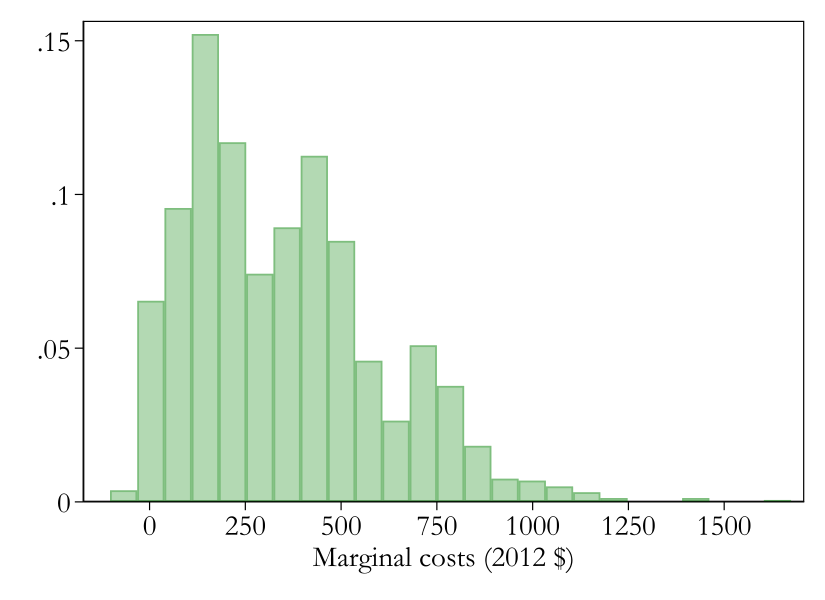
Figure 2 displays the distribution of
estimated marginal costs across all products.
Notes: Histogram of estimated marginal costs (deflated to
2012 dollars) across all products in the sample.
Figure 2: Histogram of product-level
marginal cost estimates
Finally, Table 3 quantifies how marginal costs
depend on labor costs (captured by the deflated RER), product
characteristics, and brand, retailer, and year fixed effects. As labor
costs increase, the estimated marginal cost increases. Furthermore,
top-loaders with an agitator have lower marginal costs than
high-efficiency top-loaders and front-loaders.
Table 3: Marginal cost decomposition
Marginal costs (2012
$)
Real Exchange Rate
199.324\(^{***}\)
(36.869)
Front-Loader
21.042
(20.161)
Agitator
\(-\)244.397\(^{***}\)
(26.696)
Characteristics
Yes
Retailer FE
Yes
Brand FE
Yes
Brand time trends
Yes
Year FE
Yes
N
1,586
Notes: The table presents regression results of
product-level marginal costs on proxies for labor and shipping costs,
product characteristics, fixed effects, and brand-specific time trends.
Standard errors are clustered at the brand level. Significance levels:
\(^{*}\)\(p<0.10\), \(^{**}\)\(p<0.05\), \(^{***}\)\(p<0.01\).
Quantifying the Trade-Policy Channel for
Whirlpool
In this section, I quantify the components of the trade-policy
channel for Whirlpool’s domestic acquisition of Maytag, assessing how
the merger affected the profitability of petitioning across the
different rounds of tariff actions observed between 2011 and 2018. To
contrast this with the trade-policy channel of a cross-border merger, I
perform the same analysis for a hypothetical merger between Whirlpool
and LG.
Trade-Policy Channel
of a Domestic Merger
To assess how acquiring Maytag affected Whirlpool’s incentives to
petition for tariffs, I quantify the appropriation and strategic effects
(equations (20) and (21)) for different
tariff-origin scenarios. I also estimate the corresponding consumer
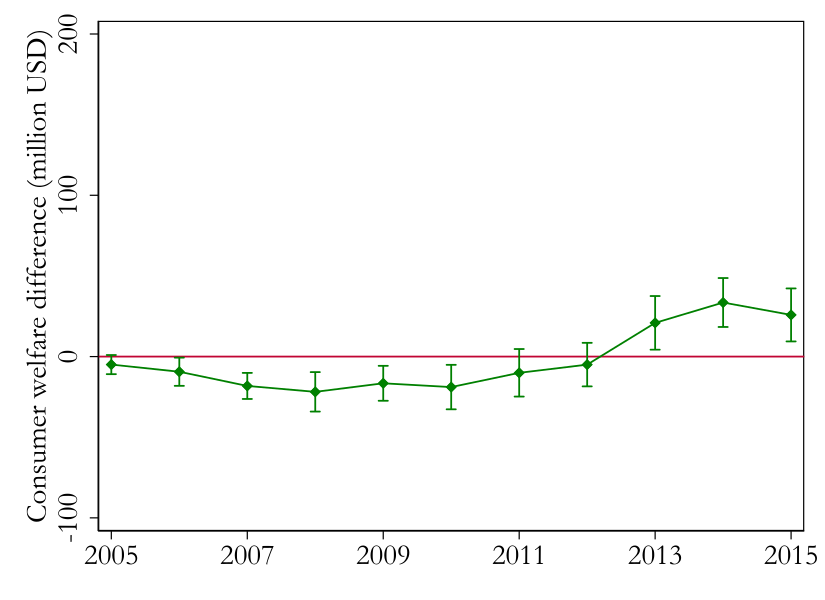
surplus effect \(\Delta CS^{\mathcal
M}(\kappa,O)\) defined in equation (23).
While I observe realized tariff outcomes and relocation responses by
LG and Samsung, the simulations do not incorporate this ex post
information. Ex ante, petitioners cannot perfectly predict final tariffs
or rivals’ immediate relocation strategies; for instance, preliminary AD
margins on LRW imports from China were substantially revised downward
between preliminary and final determinations (LG: \(49.88\%\rightarrow 32.12\%\); Samsung:
\(111.09\%\rightarrow 52.51\%\)). I
instead simulate uniform ad valorem tariffs of \(\kappa=50\%\) applied to three origin
groups, \[O \in \{\text{Korea+Mexico},\
\text{China+Korea+Mexico},\ \text{Global}\},\] which mirror the
historical sequence (2011 Korea and Mexico; 2015 China; 2018 global
safeguards).AD/CVD
petitions on imports from Korea and Mexico, as well as China, were filed
in 2011 and 2015, respectively. Final duty determinations were made in
2013 and 2016, respectively.
For each calendar year \(t\), I
recompute the Bertrand-Nash pricing equilibrium under explicit
production-location assumptions. Under a tariff \((\kappa,O)\), Whirlpool and Maytag reshore
any remaining foreign washer production to the U.S. in year \(t\), while all other firms’ production
locations are held at their year-\(t\!-\!1\) configuration. This mirrors the
domestic incumbents’ ex ante decision problem: rivals’ locations are
expected to persist in the near term, and securing protection is
anticipated to require reshoring by the petitioner.
I compare tariff scenarios to two no-tariff baselines. In the
status-quo baseline, Maytag and Whirlpool’s production
locations remain at where they were in year \(t\!-\!1\). In the incumbent-offshoring
baseline, Whirlpool and Maytag additionally offshore front-loader
production to Mexico in year \(t\)
(top-loaders are not
offshored).Top-loader
offshoring is never observed in the data. All rivals’ production
locations always remain at their locations in year \(t\!-\!1\).
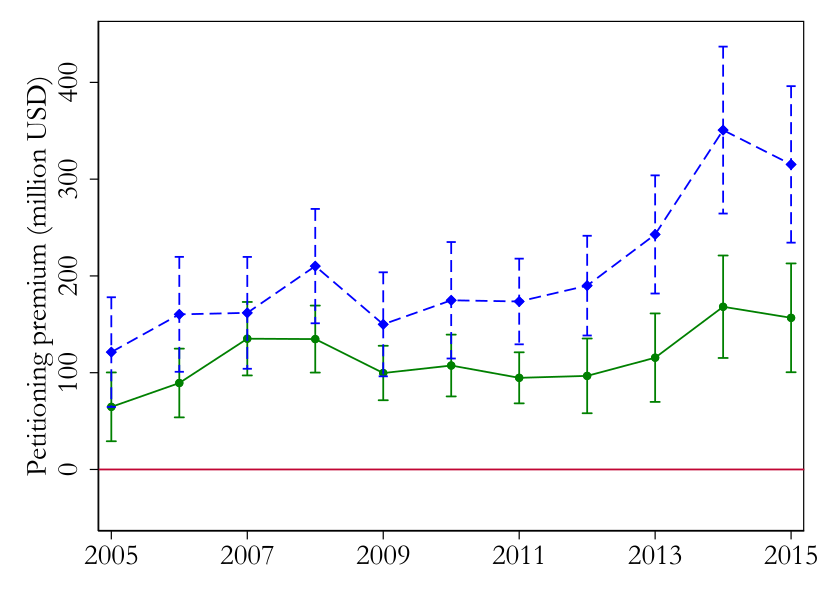
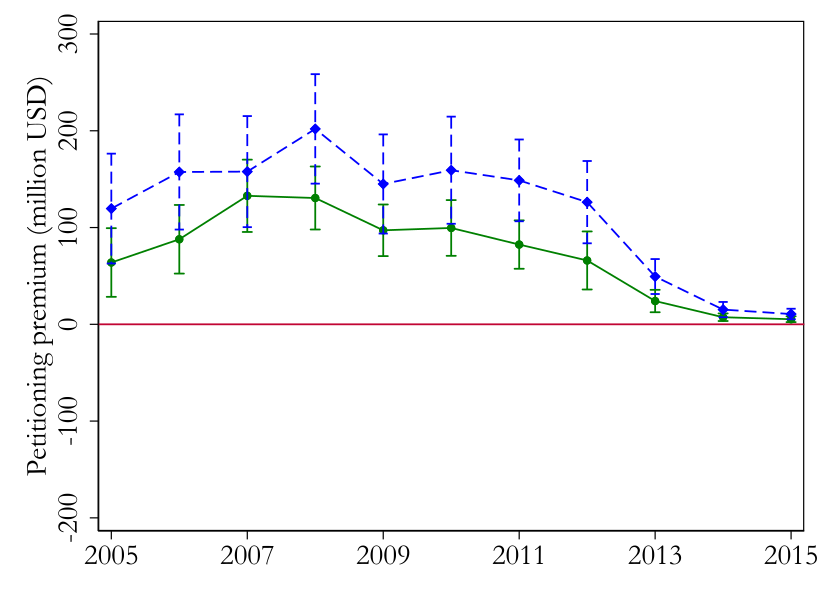
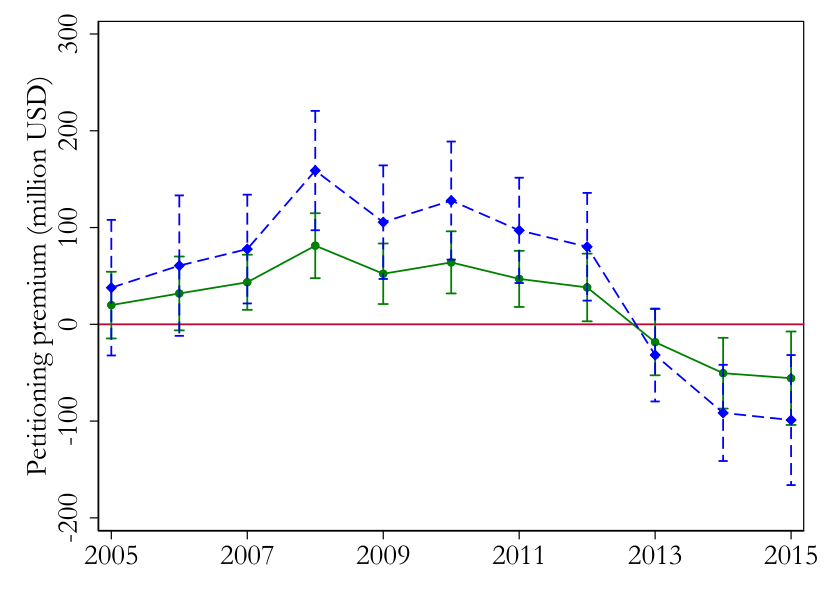
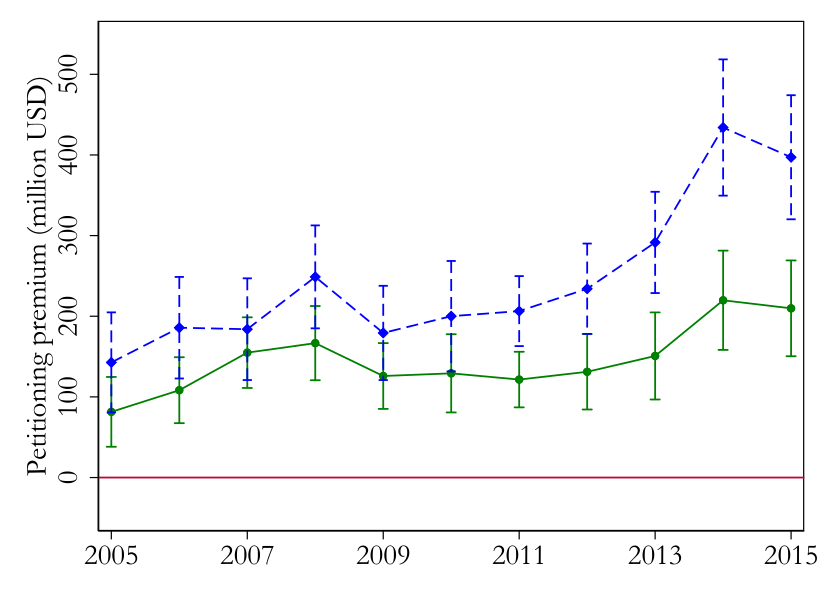
A. Global, status-quo
B. Global, offshoring
Notes: The figure plots Whirlpool’s variable profit from a
\(50\%\) global import tariff relative
to its no-tariff alternative (the status-quo production configuration in
Panel A, offshoring in Panel B), by year, without the merger (solid
green) and under the Whirlpool–Maytag merger (dashed blue). Positive
values indicate that petitioning is more profitable than the alternative
in variable-profit terms. \(95\%\)
bootstrap confidence intervals are obtained by resampling the demand and
cost shocks (\(\xi\) and \(\omega\)) from their empirical joint
distribution within brand.
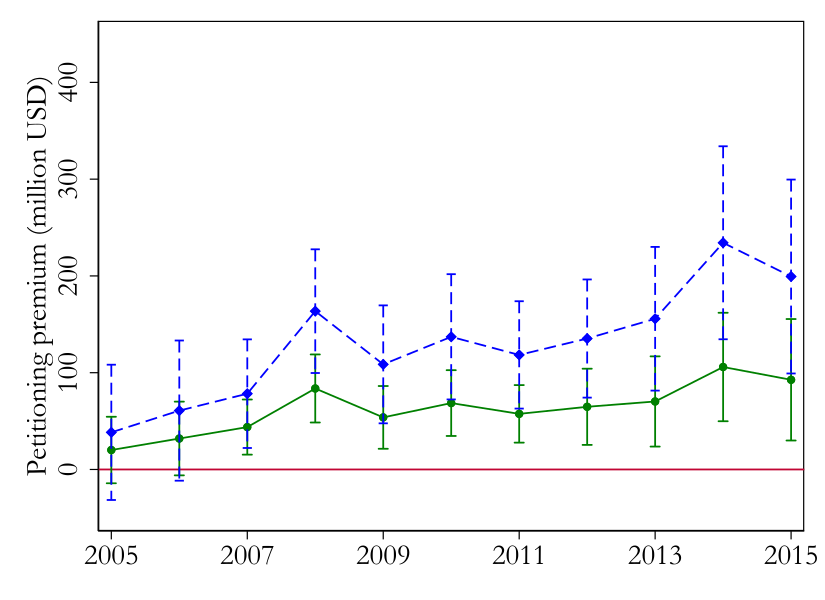
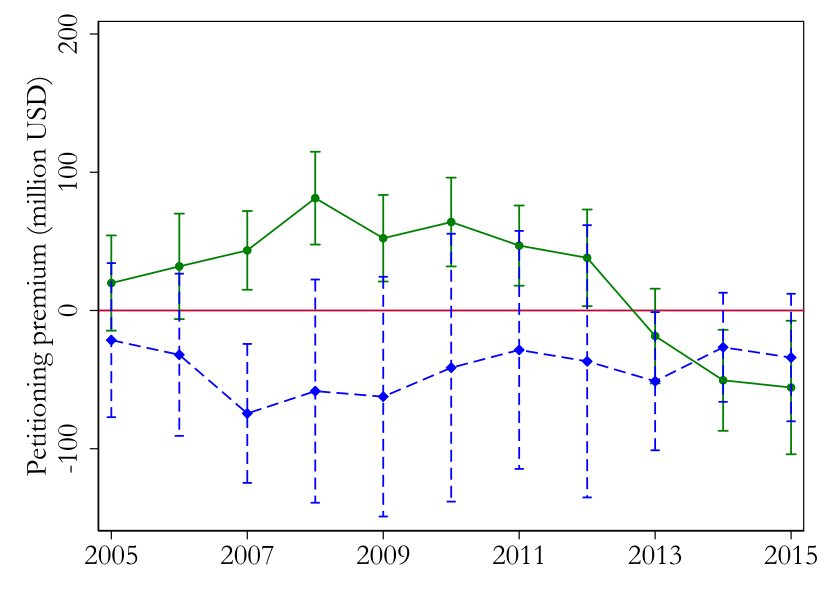
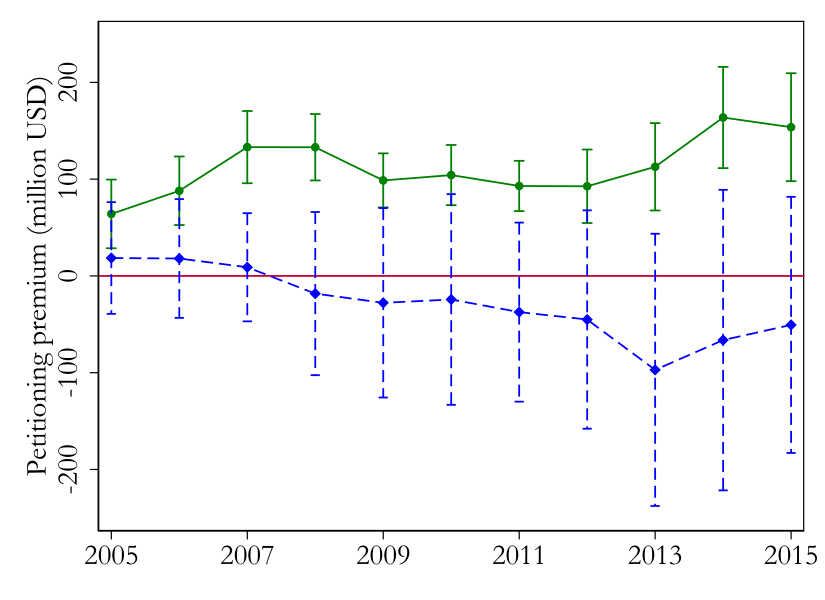
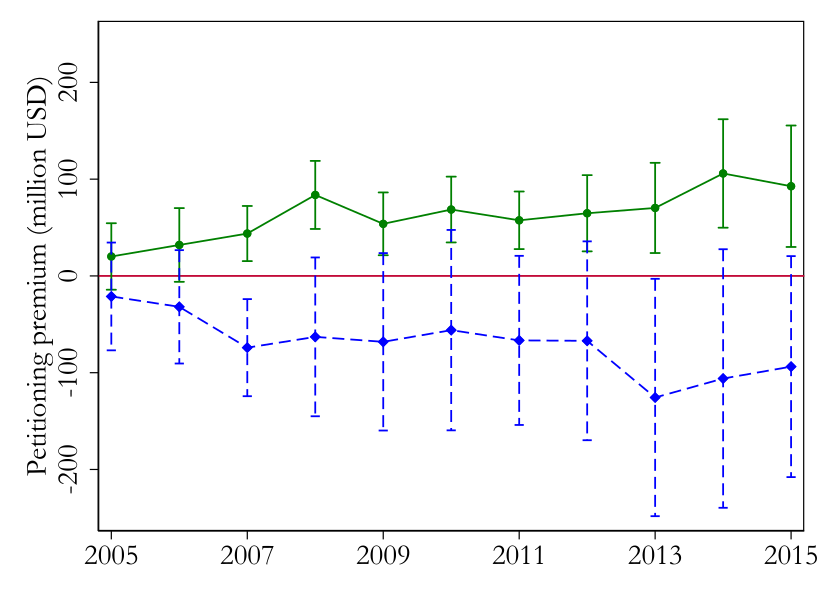
Figure 3: Domestic merger: petitioning
versus its no-tariff alternative, \(\kappa =
50\%\), global tariffs
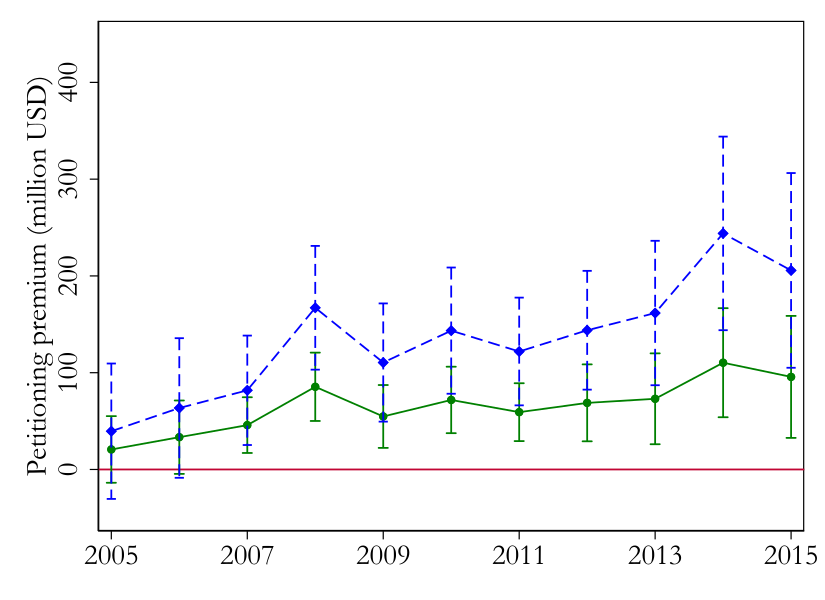
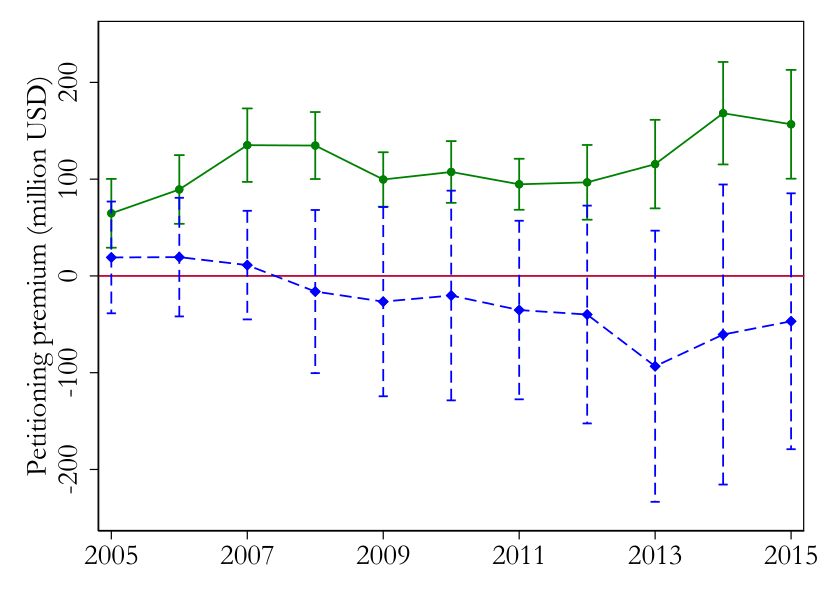
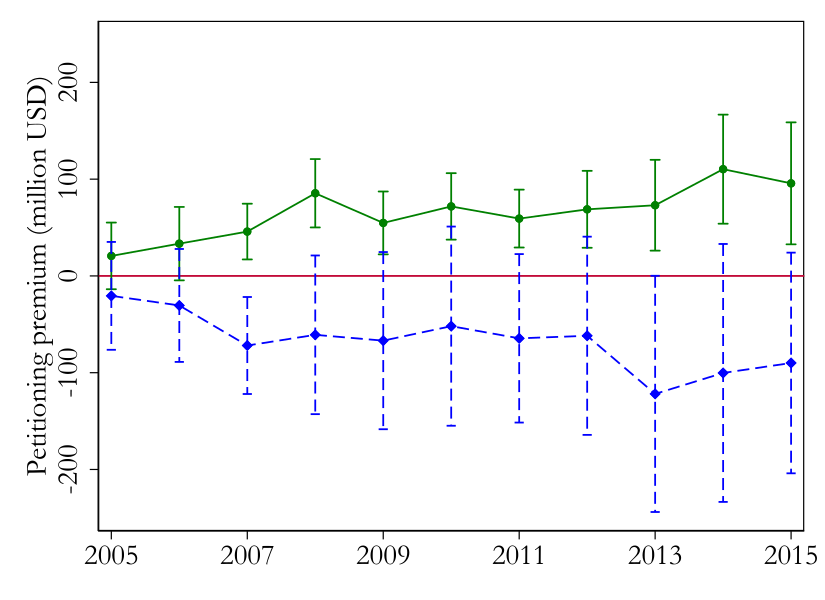
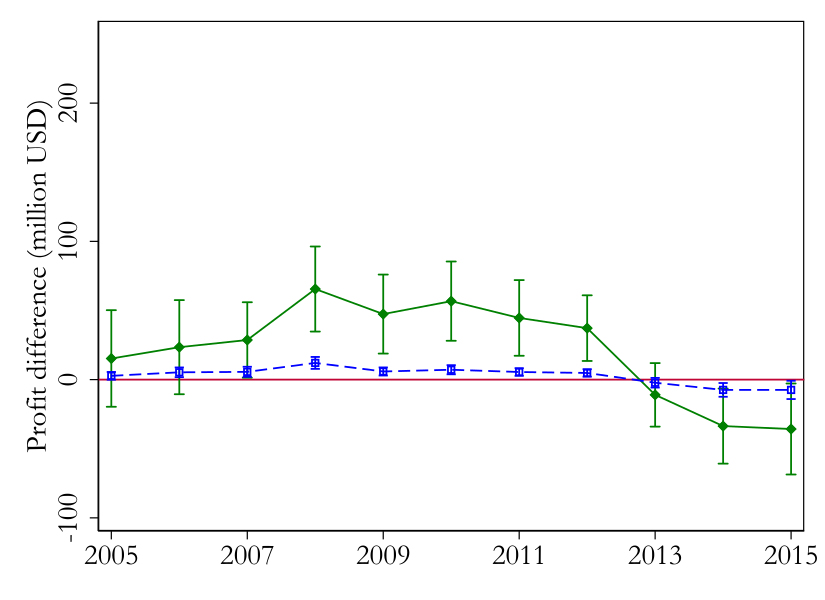
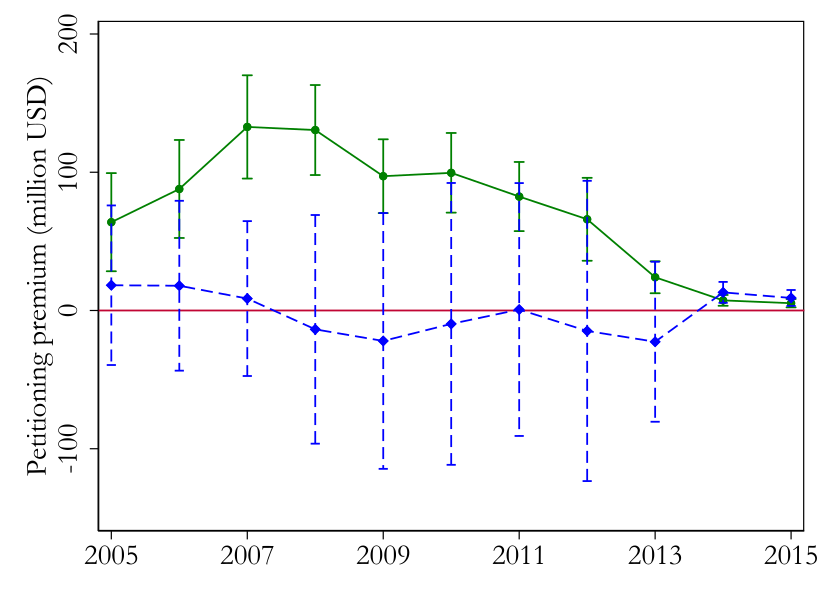
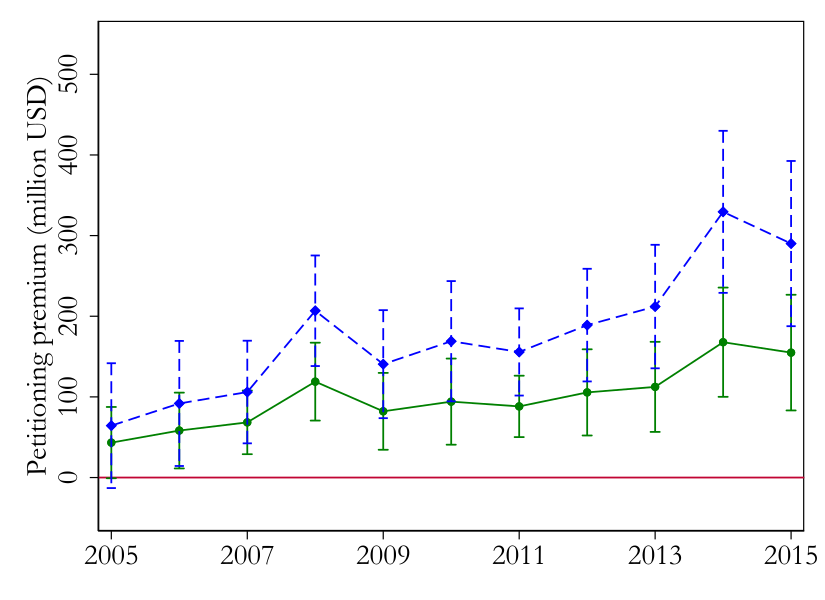
Figure 3 reports the profitability of
petitioning relative to its no-tariff alternative for Whirlpool in each
year, with and without the Maytag acquisition, under two baselines.
Panel A shows the premium of petitioning over the status quo, \(\pi^{\text{pet}}-\pi^{\text{sq}}\). It
becomes immediately clear that if the alternative is the status quo,
then petitioning is highly profitable in variable profit terms and the
merger increases its profitability. However, since the status quo is
dominated by offshoring, the relevant comparison to petitioning should
also be offshoring.
Panel B shows the premium of petitioning over offshoring, \(\pi^{\text{pet}}-\pi^{\text{off}}\). Two
patterns emerge. First, the premium rises as import competition
intensifies, from about $20 million in 2005 to about $95 million in 2015
absent the merger. As the combined market share of LG and Samsung grows
over the period, a tariff that raises foreign costs becomes more
valuable relative to lowering Whirlpool’s own costs through offshoring.
Second, the merger shifts the premium upward in every year. The gap
between the two lines is the merger’s effect on the incentive to
petition, which I decompose into an appropriation and a strategic effect
below.
This comparison is in variable profits and abstracts from the fixed
costs of each option. A \(50\%\) global
tariff is a strong instrument, so the premium is positive throughout the
sample. The figure therefore overstates how early petitioning becomes
worthwhile. Petitioning requires paying the filing cost and reshoring
production to establish standing, whereas offshoring, already under way
by the late 2000s, entailed no further fixed cost. The duties actually
sought in the first rounds were also smaller and narrower than a \(50\%\) global tariff. Net of these costs,
the rising premium is consistent with Whirlpool turning to trade
protection only as import competition strengthened, filing its first
petition in 2011.
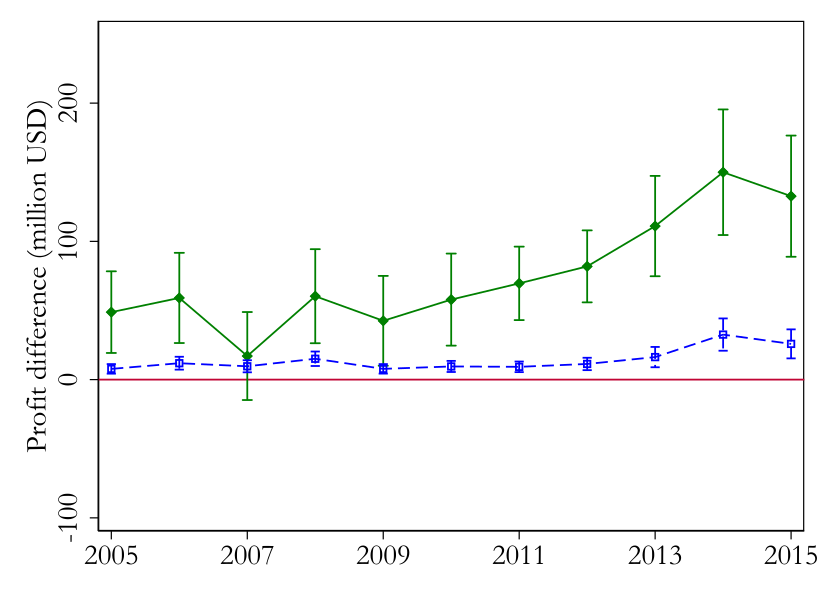
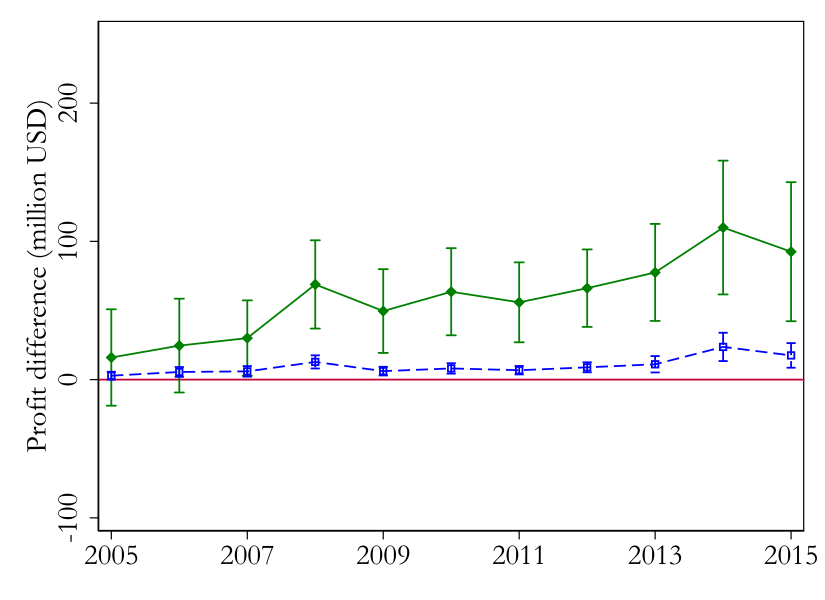
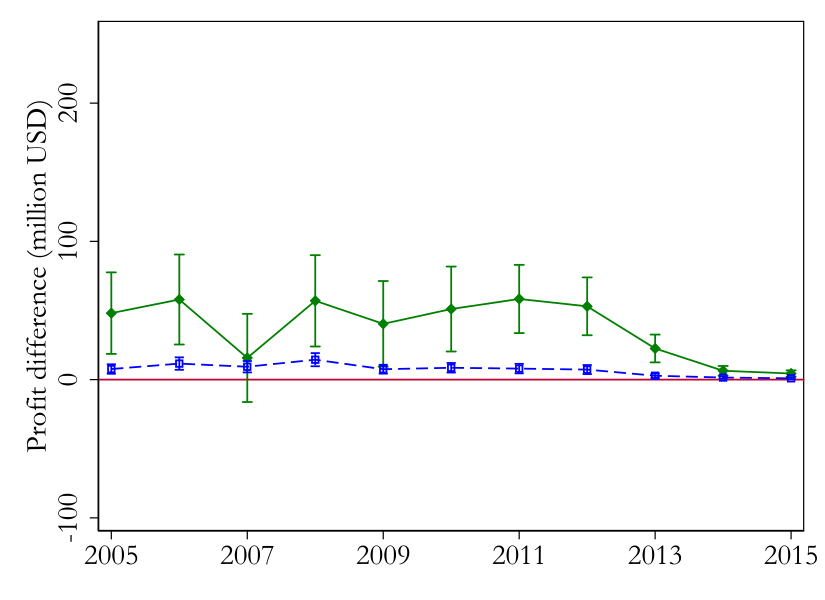
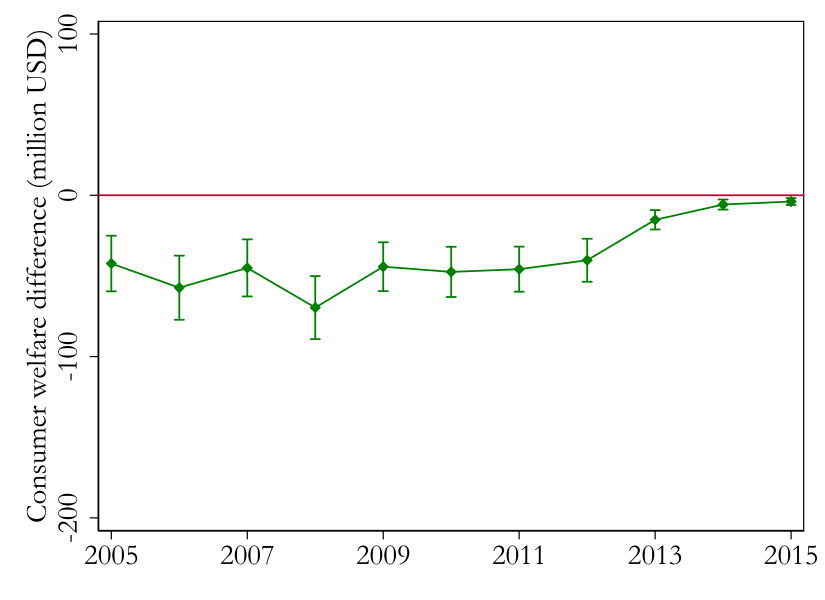
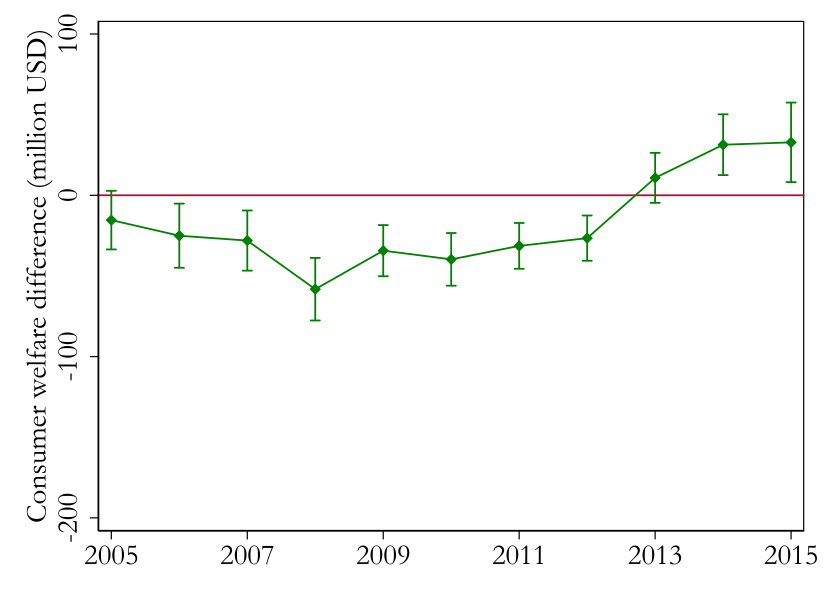
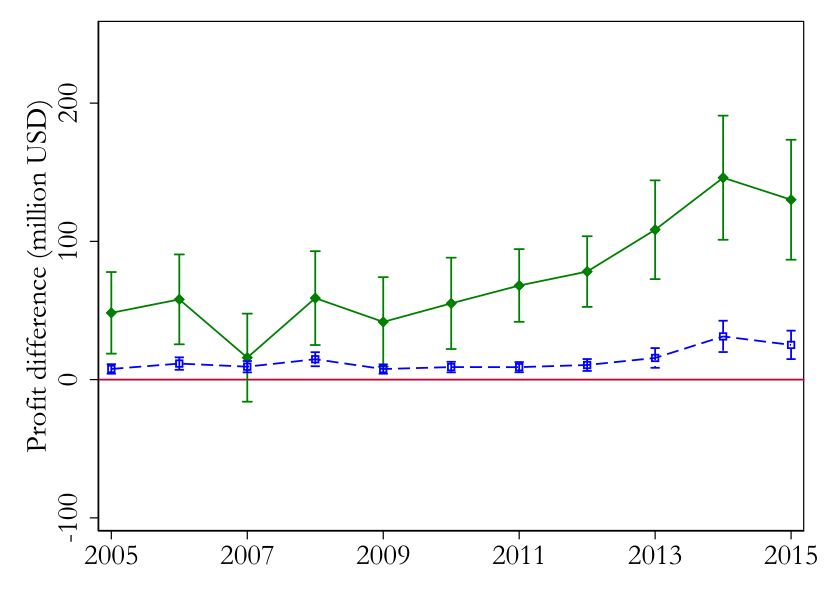
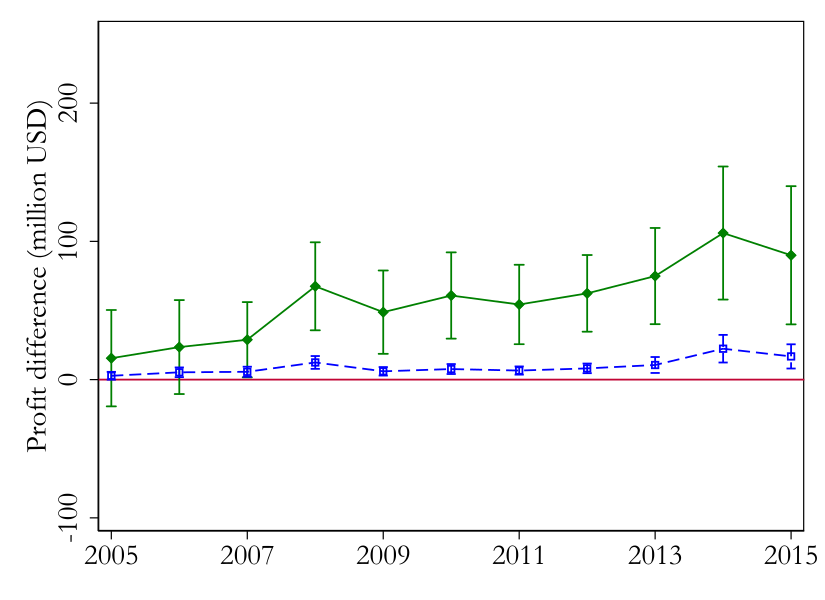
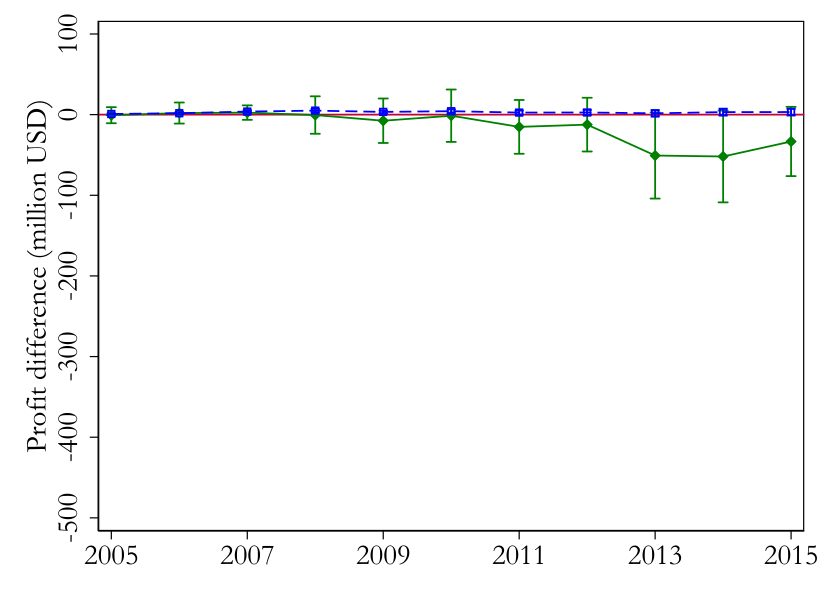
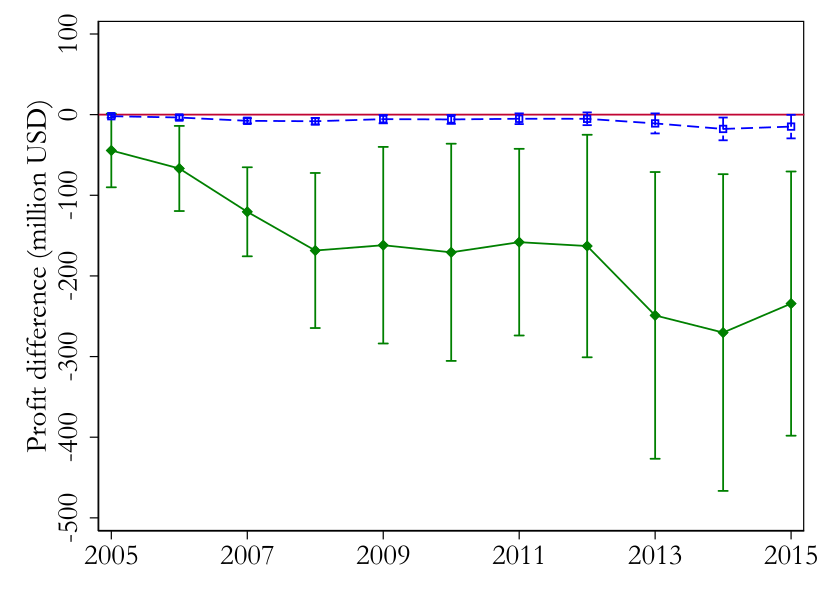
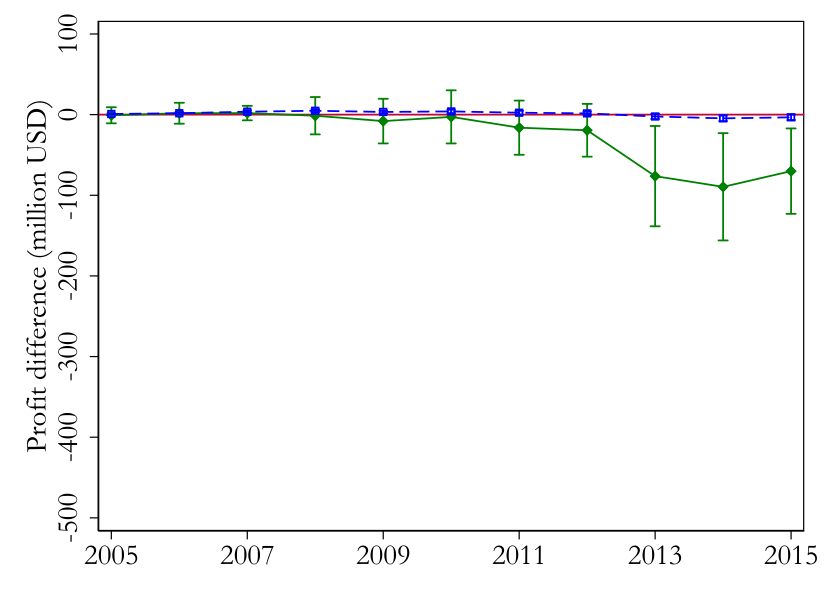
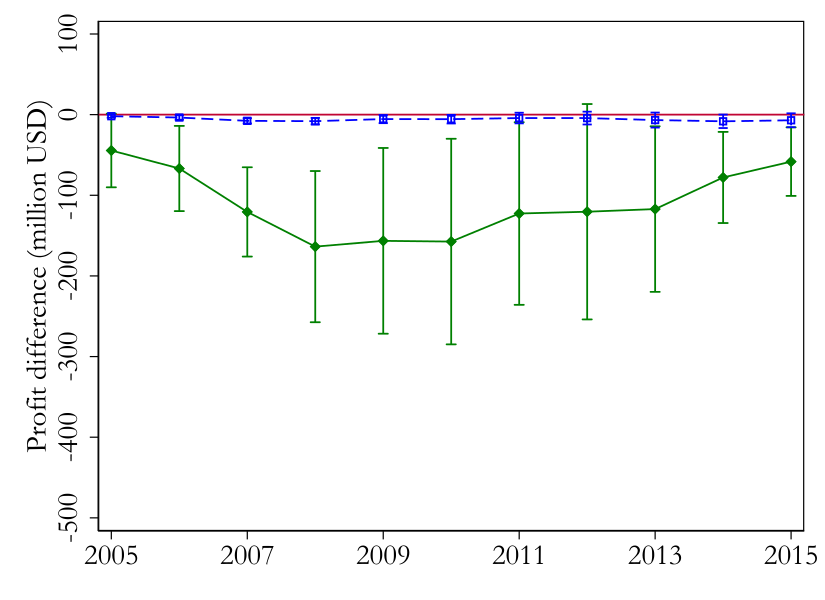
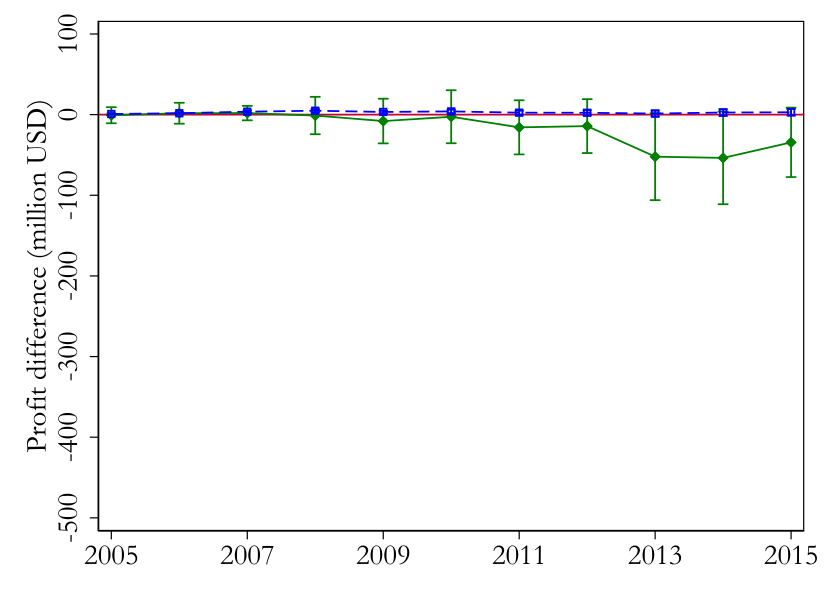
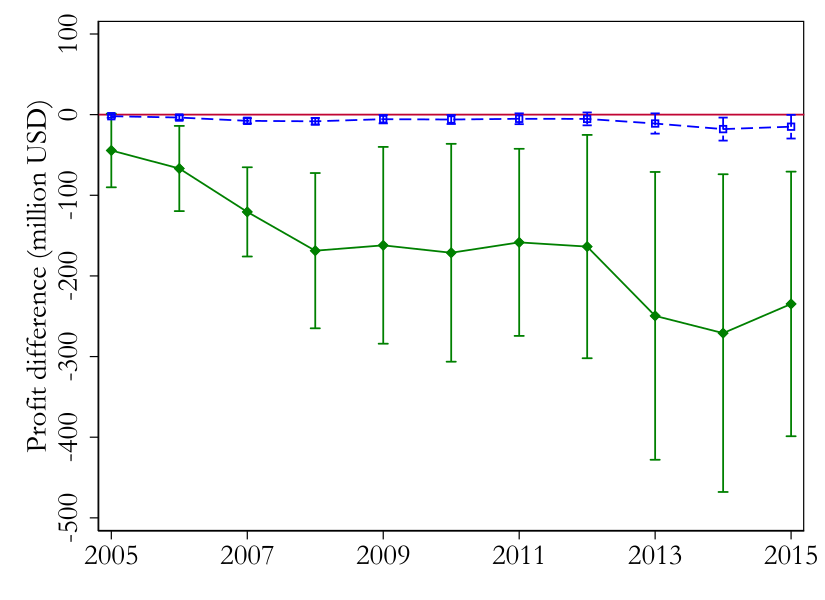
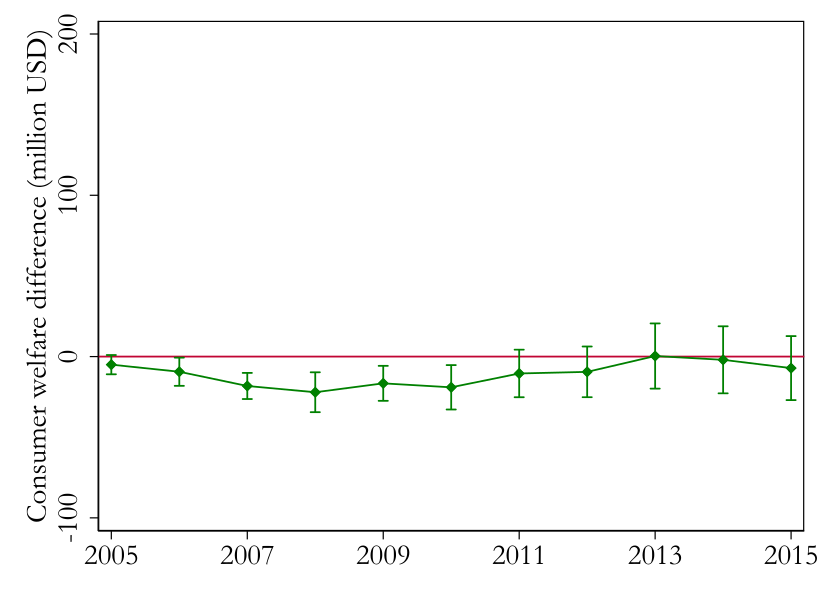
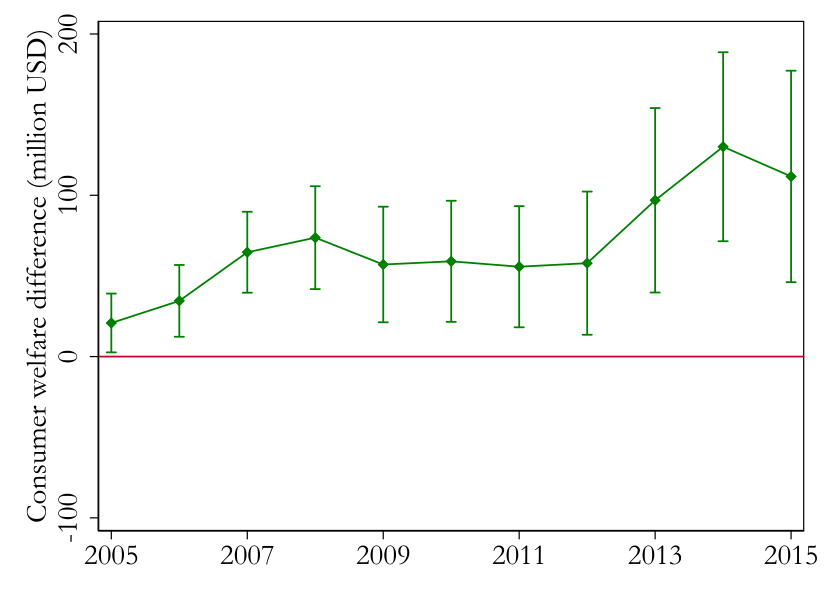
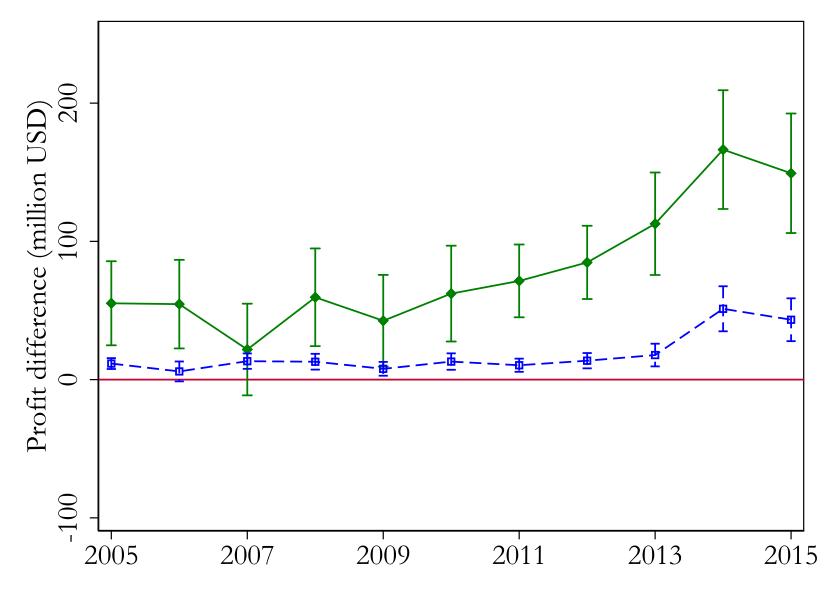
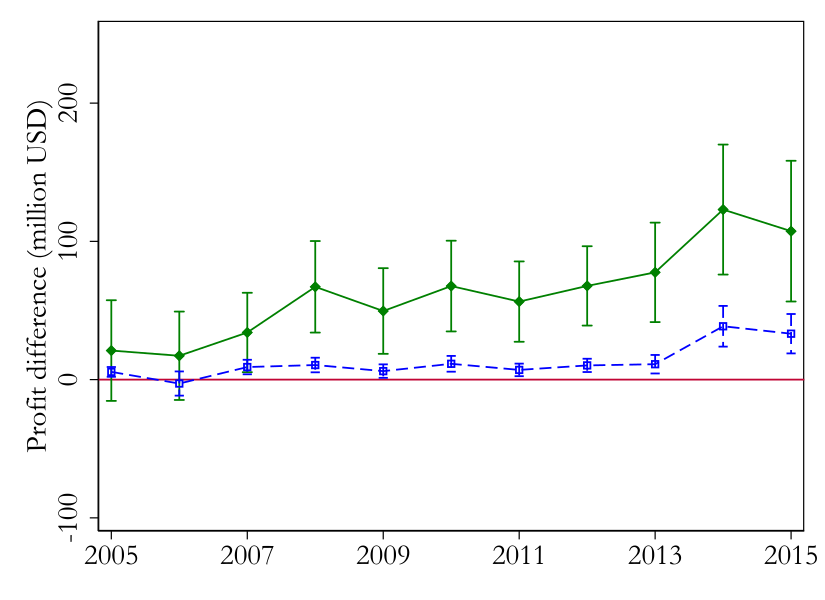
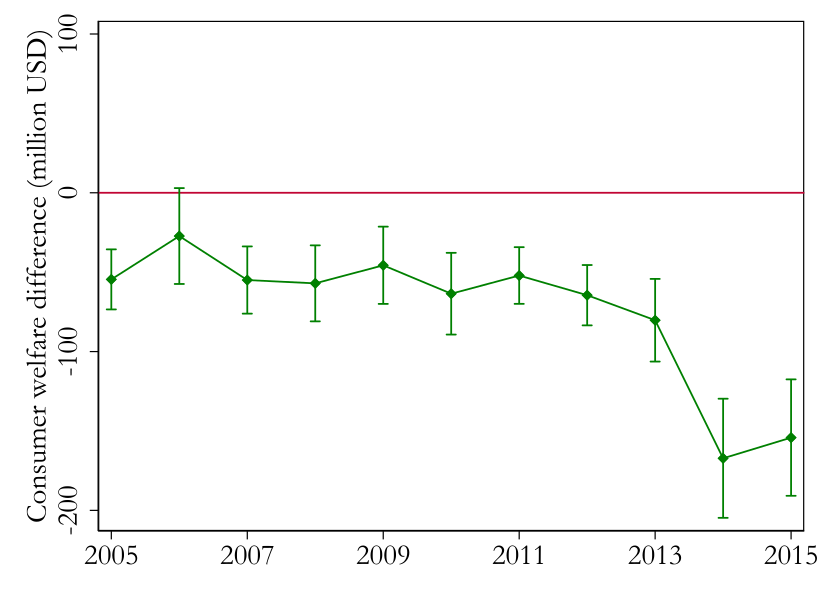
Figure 4 plots the appropriation and
the strategic effect of acquiring Maytag for Whirlpool from a \(50\%\) global tariff on imports of large
residential washers. The panels compare results against the
status-quo baseline and the incumbent-offshoring
baseline.
A. Global, status-quo
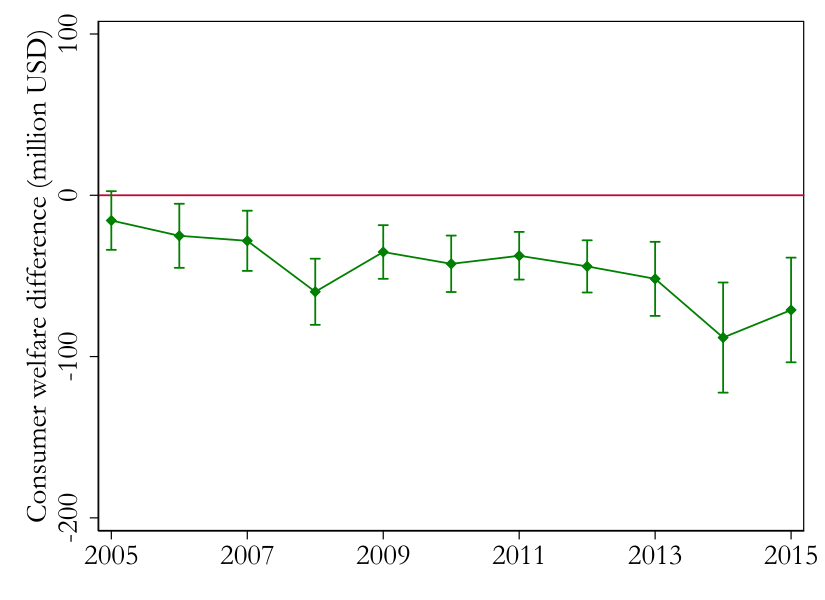
B. Global, offshoring
Notes: The figure shows how for a Whirlpool–Maytag merger
the appropriation effect (solid green line) and the
strategic effect (dashed blue line) change Whirlpool’s profits
from a \(50\%\) global tariff. \(95\%\) bootstrap confidence intervals are
obtained by resampling the demand and cost shocks (\(\xi\) and \(\omega\)) from their empirical joint
distribution within brand.
Figure 4: Domestic merger: appropriation
and strategic effects, \(\kappa =
50\%\), global tariffs
The merger increases the profitability of global import tariffs for
Whirlpool. While both the appropriation and strategic effects increase
the profitability of petitioning for trade protection, most of the
trade-policy channel comes through the appropriation effect. The
strategic effect is about five times smaller than the appropriation
effect.
Figure 5 shows the merger-induced increase
in consumer surplus losses from a \(50\%\) global tariff. The merger amplifies
the consumer harm from tariffs. Depending on the year, the
merger-induced increase in annual consumer harm from a global tariff
exceeds $100 million under the status-quo baseline. These figures do not
account for any change in the probability of
petitioning.Results
for tariffs on imports from Korea and Mexico or China, Korea and Mexico
only are reported in Appendix 11.1.
A. Global, status-quo
B. Global, offshoring
Notes: The figure shows how a Whirlpool–Maytag merger
changes the consumer surplus effect of a \(50\%\) global tariff. \(95\%\) bootstrap confidence intervals are
obtained by resampling the demand and cost shocks (\(\xi\) and \(\omega\)) from their empirical joint
distribution within brand.
Table 4 reports the estimates of the
effect of introducing a \(50\%\) tariff
for the different tariff scenarios in the year of filing (or the final
year of the data in the case of global tariffs). The first column
reports the tariff-induced change in profits for Whirlpool in the
absence of the merger. The appropriation and strategic effects together
give the merger-induced increase in Whirlpool’s profits from tariffs. In
most scenarios, acquiring Maytag more than doubles Whirlpool’s profits
from tariffs. This suggests that the merger substantially increased the
likelihood of a tariff petition.
Table 4: Trade-policy channel of a domestic
merger, \(\kappa = 50\%\)
Whirlpool
profits
Consumer
surplus
No merger
Appropriation
Strategic
No merger
\(\Delta
CS^{\mathcal{M}}\)
Panel A: Korea+Mexico
tariffs (Year: 2011)
Status quo
$82M
$58M
$8M
\(-\)$443M
\(-\)$46M
[$57M, $107M]
[$33M, $84M]
[$4M, $12M]
[\(-\)$566M, \(-\)$319M]
[\(-\)$61M, \(-\)$31M]
Offshoring
$47M
$45M
$6M
\(-\)$498M
\(-\)$31M
[$18M, $76M]
[$17M, $73M]
[$3M, $8M]
[\(-\)$620M, \(-\)$377M]
[\(-\)$46M, \(-\)$16M]
Panel B:
China+Korea+Mexico tariffs (Year: 2015)
Status quo
$154M
$130M
$25M
\(-\)$585M
\(-\)$108M
[$98M, $209M]
[$85M, $175M]
[$15M, $35M]
[\(-\)$756M, \(-\)$415M]
[\(-\)$139M, \(-\)$76M]
Offshoring
$93M
$90M
$17M
\(-\)$708M
\(-\)$71M
[$30M, $155M]
[$38M, $141M]
[$8M, $26M]
[\(-\)$877M, \(-\)$539M]
[\(-\)$104M, \(-\)$38M]
Panel C: Global tariffs
(Year: 2015)
Status quo
$157M
$133M
$26M
\(-\)$596M
\(-\)$110M
[$100M, $213M]
[$87M, $178M]
[$15M, $36M]
[\(-\)$767M, \(-\)$425M]
[\(-\)$143M, \(-\)$78M]
Offshoring
$96M
$93M
$18M
\(-\)$718M
\(-\)$74M
[$33M, $159M]
[$41M, $144M]
[$8M, $27M]
[\(-\)$888M, \(-\)$549M]
[\(-\)$107M, \(-\)$40M]
Notes: Values in million USD per year. The table reports
point estimates of the profitability of tariffs to Whirlpool without
acquiring Maytag (no merger), and the merger-induced change decomposed
into the appropriation and strategic effects. Consumer surplus columns
report the change in consumer surplus from tariffs without the merger
and the merger-induced additional consumer harm. 95% bootstrap
confidence intervals in brackets. See Table 7 for results treating
Kenmore top-loaders as Whirlpool products and Kenmore front-loaders as
LG products.
The final two columns report the consumer surplus loss from a \(50\%\) tariff without the merger and the
additional loss attributable to the merger. Two observations stand out.
First, the consumer surplus loss from tariffs is substantial. Even in
the absence of the merger, a \(50\%\)
global tariff on washers decreases consumer surplus by around
$718 million if the alternative is offshoring. Second, the merger
substantially increases the consumer harm from tariffs. For instance, in
the global tariff scenario, the merger increases the consumer surplus
loss from a \(50\%\) tariff by around
$74 million if the alternative is
offshoring.The
total annual consumer surplus loss from the global import tariffs is of
the same order of magnitude as the $841 million annual consumer surplus
loss from the actual global tariffs implemented in 2018 estimated by
Flaaen et al.
(2020). They use a difference-in-differences design to estimate
the price effect of the tariffs and multiply it by the total number of
washing machines transacted pre-tariff. The environments differ in
several respects: the actual tariff was \(20\%\) on the first 1.2 million washers and
\(50\%\) only beyond that, and Samsung
relocated production to the U.S. during their observation
period.
The total effect of the trade-policy channel on consumers combines
the harm induced by the increased likelihood of tariffs with the harm of
the tariffs conditional on being imposed. Consider the 2015 global
tariff relative to the offshoring baseline. The merger doubles
Whirlpool’s profits from the tariff, making a petition and the
subsequent tariff substantially more likely.
To illustrate the magnitude of this channel, suppose the merger makes
a petition and the subsequent tariff a certainty. If this reflects a
\(10\) percentage-point increase over
the no-merger baseline, consumers face an extensive-margin expected loss
of \(0.10\times\$718\text{M}\approx\$72\) million.
Furthermore, because the post-merger tariff occurs with probability one
under this assumption, consumers fully bear the $74 million in
additional conditional harm. Adding these gives about $150 million per
year in expected consumer harm through the trade-policy channel. For
comparison, Montag
(2026) estimates that the direct market-power related annual
consumer harm from the Whirlpool–Maytag merger is $225 million for
clothes washers. This shows that the magnitude of the trade-policy
channel can be substantial.
Trade-Policy
Channel of a Cross-Border Merger
Proposition 6
shows that in a cross-border merger, two of the three channels in the
petitioning-premium decomposition unambiguously reduce the incentive to
petition under the status-quo baseline, suggesting that cross-border
mergers lower the demand for protectionism.
To illustrate this point, I repeat the previous simulations for a
cross-border merger between Whirlpool and LG. To make this comparable to
the domestic-merger simulations, I demerge all Maytag brands from
Whirlpool across all years. I assume that Maytag always produces in the
U.S., whereas in the absence of petitioning, Whirlpool and LG either
keep their observed production locations or offshore wherever feasible.
Since LG is only producing abroad throughout the sample and Whirlpool
never produces top-loaders outside the U.S., the offshoring scenario
simply moves Whirlpool’s front-loader production to Mexico.
Figure 6 repeats the
petitioning-premium comparison of Figure 3 for
the cross-border Whirlpool–LG merger. Whereas the domestic merger raises
the premium, the cross-border merger lowers it and pushes it below zero,
so the merged firm strictly prefers offshoring to petitioning. The
benefits of petitioning are limited, since the tariff now protects the
merged entity only against Samsung, while the costs are substantial. In
particular, petitioning requires the merged Whirlpool–LG to relocate
LG’s production to the U.S. and absorb the associated cost increase.
Because the premium is measured in variable profits and omits this
relocation cost, it understates how unattractive petitioning is for the
merged firm.
A. Global, status-quo
B. Global, offshoring
Notes: The figure plots Whirlpool’s variable profit from a
\(50\%\) global import tariff relative
to its no-tariff alternative (the status-quo production configuration in
Panel A, offshoring in Panel B), by year, without the cross-border
merger (solid green) and under the Whirlpool–LG merger (dashed blue).
Positive values indicate that petitioning is more profitable than the
alternative in variable-profit terms. \(95\%\) bootstrap confidence intervals are
obtained by resampling the demand and cost shocks (\(\xi\) and \(\omega\)) from their empirical joint
distribution within brand.
Figure 6: Cross-border merger: petitioning
versus its no-tariff alternative, \(\kappa =
50\%\), global tariffs
Table 5 reports the corresponding
point estimates and bootstrap confidence intervals for all three tariff
scopes. Appendix Figure A.7
decomposes the merger’s effect into the appropriation effect, now
negative, and the strategic effect, and the results for the Korea+Mexico
and China+Korea+Mexico tariffs are reported in Appendix 11.2.
Table 5: Trade-policy channel of a
cross-border merger, \(\kappa =
50\%\)
Whirlpool
profits
Consumer
surplus
No merger
Appropriation
Strategic
No merger
\(\Delta
CS^{\mathcal{M}}\)
Panel A: Korea+Mexico
tariffs (Year: 2011)
Status quo
$82M
\(-\)$81M
\(-\)$1M
\(-\)$443M
$17M
[$57M, $107M]
[\(-\)$175M, $14M]
[\(-\)$4M, $2M]
[\(-\)$566M, \(-\)$319M]
[\(-\)$3M, $38M]
Offshoring
$47M
\(-\)$73M
\(-\)$2M
\(-\)$498M
$22M
[$18M, $76M]
[\(-\)$161M, $15M]
[\(-\)$7M, $2M]
[\(-\)$620M, \(-\)$377M]
[\(-\)$3M, $47M]
Panel B:
China+Korea+Mexico tariffs (Year: 2015)
Status quo
$154M
\(-\)$196M
\(-\)$8M
\(-\)$585M
$70M
[$98M, $209M]
[\(-\)$332M, \(-\)$61M]
[\(-\)$15M, \(-\)$1M]
[\(-\)$756M, \(-\)$415M]
[$33M, $106M]
Offshoring
$93M
\(-\)$176M
\(-\)$10M
\(-\)$708M
$77M
[$30M, $155M]
[\(-\)$299M, \(-\)$53M]
[\(-\)$19M, \(-\)$1M]
[\(-\)$877M, \(-\)$539M]
[$36M, $119M]
Panel C: Global tariffs
(Year: 2015)
Status quo
$157M
\(-\)$196M
\(-\)$8M
\(-\)$596M
$69M
[$100M, $213M]
[\(-\)$331M, \(-\)$61M]
[\(-\)$14M, \(-\)$1M]
[\(-\)$767M, \(-\)$425M]
[$33M, $105M]
Offshoring
$96M
\(-\)$176M
\(-\)$10M
\(-\)$718M
$77M
[$33M, $159M]
[\(-\)$299M, \(-\)$53M]
[\(-\)$19M, \(-\)$1M]
[\(-\)$888M, \(-\)$549M]
[$35M, $118M]
Notes: Values in million USD per year. The table reports
point estimates of the profitability of tariffs to Whirlpool without
merging with LG (no merger), and the merger-induced change decomposed
into the appropriation and strategic effects. Consumer surplus columns
report the change in consumer surplus from tariffs without the merger
and the merger-induced additional consumer harm. 95% bootstrap
confidence intervals in brackets.
Figure 7 shows that the consumer harm
from tariffs is consistently larger in the absence of a Whirlpool–LG
merger. Although tariffs always reduce consumer welfare, it is a priori
unclear whether the cross-border merger increases or decreases this
harm. The results show that competition between Whirlpool and LG is
particularly valuable if Whirlpool offshores its front-loader production
and LG remains independent. The offshoring baseline tariffs are
therefore more harmful without the merger.
A. Global, status-quo
B. Global, offshoring
Notes: The figure shows how a Whirlpool–LG merger changes
the consumer surplus effect of a \(50\%\) global tariff. \(95\%\) bootstrap confidence intervals are
obtained by resampling the demand and cost shocks (\(\xi\) and \(\omega\)) from their empirical joint
distribution within brand.
This paper shows that domestic mergers can harm consumers through a
trade-policy channel that operates over and above the merger’s direct
market-power effects.
I develop a three-stage model in which a competition authority
adjudicates a merger, the domestic incumbent chooses among petitioning
for tariffs, offshoring, or maintaining the status quo, and firms
compete in prices. When offshoring is unavailable, a domestic merger
strictly raises the profitability of petitioning through two channels:
an appropriation effect, whereby the acquirer internalizes the
trade-protection rents that would otherwise accrue to the domestic
target, and a strategic effect, whereby joint pricing amplifies the
merged firm’s gains from weakening foreign rivals. When offshoring is
available, the incumbent can raise profits by lowering its own costs
rather than raising its rivals’, and the sign of the merger’s effect
becomes ambiguous. Cross-border mergers generate the opposite forces:
internalizing the foreign target’s losses from tariffs and bearing the
cost of relocating its production reduce the incentive to petition.
Using the U.S. washer industry as a case study, I find that the
choice between offshoring and petitioning turns on the strength of
import competition. When it is weak, the merging parties prefer to lower
their own costs through offshoring; when it is strong, the merger makes
it more profitable to raise their foreign rivals’ costs through tariffs.
This is exactly when imports are most likely to be a pivotal competitive
constraint in a merger clearance decision. A hypothetical cross-border
merger, by contrast, reduces the profitability of petitioning and does
not increase consumer harm from tariffs.
These findings have implications for merger control. In markets where
imports can be restricted through trade remedies, competition
authorities should place less weight on import competition as a
constraint on the merged entity, since the merger itself can undermine
that constraint. Mergers that reduce the number of domestic producers to
one or two warrant particular scrutiny, whereas cross-border mergers can
deliver scale economies without raising the incumbents’ returns to
tariff petitions.
AD/CVD cases. Case-level AD/CVD data, including the
start date of an investigation, the identity of the petitioners, the
affected HS codes, and the final outcome and duty revocation year, come
from Bown et al.
(2025).
Product markets and production concentration.
Wherever possible, the definition of product markets comes directly from
the decisions published by the respective competition authority at the
time of merger clearance. Producer-share data are also taken from merger
decisions whenever possible and complemented by information from AD/CVD
investigations, as well as company 10-K and 20-F filings where
available. Where an agency disclosure reports each producer’s volume
share as a bracketed range rather than a point estimate, I construct the
implied bounds of the integer producer count as \(n^{80}_{low}\) and \(n^{80}_{high}\). \(n^{80}_{low}\) is the smaller count of
producers assuming each firm’s share sits at the upper bound of its
disclosed range (so fewer firms cumulate to \(80\%\)), while \(n^{80}_{high}\) is the larger count
assuming each share sits at the lower bound. The midpoint of \(n^{80}_{low}\) and \(n^{80}_{high}\) is the value that
enters the figure.
Per-case overview
Table 6 lists the 16
case-products used in Section 2. For each
case-product the table reports the jurisdiction, merger year, acquirer
and target names, and the spelled-out product market. It also reports
\(n^{80}_{-1}\) and \(n^{80}_{+1}\), whether the competition
authority listed import competition as a competitive constraint on the
merging parties post-merger, and the pre- and post-merger five-year
averages of the number of AD/CVD active cases covering the relevant
product market.
Table A.1: Cross-case sample: per-case
overview
Avg. nr. active cases
Jurisdiction
Year
Acquirer name
Target name
Product market
\(n^{80}_{-1}\)
\(n^{80}_{+1}\)
Imports cited at clearance
Pre-merger
Post-merger
Australia
2005
Capral Alum.
Crane Alum.
Aluminium extrusions
3
2
+
0.0
0.4
Brazil
2010
Braskem
Quattor
Polyethylene
2
1
+
0.0
0.0
Brazil
2010
Braskem
Quattor
Polypropylene
2
1
+
0.2
1.8
Canada
2006
Tenaris
Prudential Steel
OCTG
4.5
3.5
n.a.
1.0
2.8
EU
2007
Owens Corning
Vetrotex
Glass fibre mats
3.5
2.5
+
0.0
0.8
EU
2007
Owens Corning
Vetrotex
Glass fibre rovings
3.5
2.5
+
0.0
0.8
EU
2012
Outokumpu
Inoxum
Stainless steel, hot-rolled
3.5
2.5
–
0.0
0.0
EU
2012
Outokumpu
Inoxum
Stainless steel, cold-rolled
3.5
2.5
–
0.4
0.8
EU
2008
Sappi
M-real
Wood-free coated fine paper
5.5
4.5
n.a.
0.0
0.8
EU
2008
Sappi
M-real
Coated mechanical magazine paper
5.5
4.5
n.a.
0.0
0.8
India
2018
Tata Steel
Bhushan Steel
Hot-rolled flat steel
5
4
+
2.4
2.6
India
2018
Tata Steel
Bhushan Steel
Cold-rolled flat steel
6.5
5.5
+
0.4
1.2
India
2018
Tata Steel
Bhushan Steel
Corrosion-resistant flat steel
6.5
5.5
+
0.4
1.8
U.S.
2007
U.S. Steel
Lone Star Tech.
OCTG
4
3
n.a.
1.0
1.8
U.S.
2006
Whirlpool
Maytag
Clothes washers
4
3
+
0.0
0.2
U.S.
2006
Whirlpool
Maytag
Clothes dryers
4
3
+
0.0
0.0
Notes: Where the underlying source reports producer shares
as a bracketed range, the table lists the midpoint of \([n^{80}_{\text{low}},
n^{80}_{\text{high}}]\). \(n^{80}_{t}\) at event time \(t\). The “Imports cited at clearance”
column encodes whether import competition was cited as material to the
antitrust clearance: “+” indicates the authority accepted imports as a
clearance factor; “–” indicates the merging parties argued imports were
a constraint but the authority did not accept it; “n.a.” indicates
clearance was via an expedited procedure (Competition Bureau ARC, FTC
early termination, or EC short-form decision) with no detailed reasoning
published. “Avg. nr. active cases” is the mean over \(t \in [-5,-1]\) (Pre-merger) and \(t \in [+1,+5]\) (Post-merger) of the count
of distinct active AD/CVD cases in year \(t\).
Proof of Proposition 1. Define \[F(\kappa)\;\equiv\;\pi^{\text{pet}}_1(\kappa)-L\;-\;\big(\pi^{\text{off}}_1-R_1\big).\]
A marginal increase in \(\kappa\)
raises only foreign costs \((1+\kappa)c_F\). Via best responses, \(s_j\) shift toward firm 1 and its markups
increase. Envelope and standard logit pass-through yield \(\frac{d}{d\kappa}\pi^{\text{pet}}_1(\kappa)>0\),
and \(\pi^{\text{off}}_1\) is \(\kappa\)-invariant, so \(F'(\kappa)>0\). By the maintained
assumption, \(F(0)<0\) and \(F(\hat{\kappa})>0\). By continuity and
the intermediate value theorem, there exists \(\kappa^* \in (0,\hat{\kappa})\) with \(F(\kappa^*)=0\). Strict monotonicity gives
uniqueness and the “iff” structure. ◻
Proof of Proposition 2.
In the two-product reduction (firms \(1\) and \(3\) only), let \(\pi_1^{\text{pet}}(\kappa,\delta_3)\) and
\(\pi_1^{\text{off}}(\delta_3)\) denote
firm 1’s variable profits under petitioning and offshoring,
respectively. Define \[F(\kappa,\delta_3)
\;\equiv\;
\pi^{\text{pet}}_1(\kappa,\delta_3)-L\;-\;\big(\pi^{\text{off}}_1(\delta_3)-R_1\big),\]
and let \(\kappa^*(\delta_3)\) solve
\[F(\kappa^*(\delta_3),\delta_3)=0.\]
By Proposition 1, for fixed primitives
the cutoff \(\kappa^*(\delta_3)\) is
unique and satisfies \(F_\kappa(\kappa^*(\delta_3),\delta_3)>0\)
(since only \(\pi^{\text{pet}}_1\)
depends on \(\kappa\), and a higher
duty strictly increases its profit). By the implicit function theorem,
\[\frac{d\kappa^*}{d\delta_3}
=-\,\frac{F_{\delta_3}}{F_\kappa},
\qquad
F_\kappa>0,\] so the sign of \(\frac{d\kappa^*}{d\delta_3}\) is the sign
of \(-F_{\delta_3}\).
The exposure function \(\Psi\). Consider a two-product
logit duopoly with an outside good and costs \((c_1,c_3)\). Here and in the remaining
proofs I use the aggregative-games representation of the logit pricing
game (Nocke and
Schutz 2018, 2025): each firm’s profit depends on its rivals’
prices only through the scalar aggregator \(H\equiv1+\sum_{j\in\mathcal{J}}\exp(\delta_j-\alpha
p_j)\), and the pricing game has a unique equilibrium (Nocke and Schutz 2025,
Proposition 1). Let \((p_1,p_3)\) be this equilibrium. Standard
logit algebra gives \[s_j(p)=\frac{\exp(\delta_j-\alpha
p_j)}{1+\exp(\delta_1-\alpha p_1)+\exp(\delta_3-\alpha p_3)},
\qquad
\frac{\partial s_1}{\partial \delta_3}
=-\,s_1 s_3 \;<\;0
\quad\text{for fixed prices.}\] Equilibrium markups satisfy the
single-product condition \[p_j-c_j=\frac{1}{\alpha(1-s_j)}.\] Profits
are \(\pi_1=(p_1-c_1)s_1\).
Differentiating with respect to \(\delta_3\) and using the envelope theorem
(\(\partial\pi_1^*/\partial p_1=0\))
yields \[\frac{d \pi_1^*}{d \delta_3}
=
(p_1-c_1)\,\Big(
\underbrace{\frac{\partial s_1}{\partial \delta_3}}_{(-)}
+
\underbrace{\frac{\partial s_1}{\partial
p_3}}_{(+)}\underbrace{\frac{dp_3}{d\delta_3}}_{(+)}
\Big).\] The first term (direct share loss) is negative. The
second term (strategic price response) is positive, as the rival raises
price in response to higher quality (\(\partial p_3/\partial \delta_3 > 0\)),
which softens the market share loss. Solving the two equilibrium pricing
conditions for the price response and substituting back gives the closed
form \[\frac{d \pi_1^*}{d \delta_3}
=-\Psi,
\qquad
\Psi\equiv(p_1-c_1)\,s_1 s_3\,\frac{1-s_3}{1-D},
\qquad
D\equiv\frac{(s_1 s_3)^2}{(1-s_1)(1-s_3)},\] which is strictly
negative at any interior equilibrium, since \(D\le s_1 s_3\le \tfrac14\) when \(s_1+s_3<1\). A stronger foreign product
always erodes firm 1’s profit; the exposure\(\Psi>0\) measures by how much. For fixed
\(\alpha\), the equilibrium shares, and
hence \(\Psi\), depend on the
primitives only through \(T_j\equiv\exp(\delta_j-\alpha c_j)\), each
firm’s type(Nocke and Schutz 2025, sec. 2). Write
\(\Psi(T_1,T_3)\). The two regimes
evaluate \(\Psi\) at different points.
Petitioning keeps firm 1 at the domestic cost and scales the foreign
type down by the duty, so with \(\varepsilon\equiv\alpha(c_D-c_F)>0\) and
\(\Delta\equiv\alpha\kappa c_F>0\),
\[F_{\delta_3}
=
\frac{d \pi^{\text{pet}}_1}{d \delta_3}
-
\frac{d \pi^{\text{off}}_1}{d \delta_3}
=\Psi\big(T_1^{\text{off}},T_3^{\text{off}}\big)-\Psi\big(e^{-\varepsilon}\,T_1^{\text{off}},\;e^{-\Delta}\,T_3^{\text{off}}\big),\]
where \(T_j^{\text{off}}\equiv\exp(\delta_j-\alpha
c_F)\).
\(\Psi\) vanishes at both
extremes of \(T_3\). Fix \(T_1\). Combining the share formula with the
markup condition, the equilibrium conditions read \(s_j H=T_j\,e^{-1/(1-s_j)}\), the
fitting-in relation of the aggregative framework. As \(T_3\to0\), \(H\ge1\) gives \(s_3\le T_3/e\to0\), while \(s_1e^{1/(1-s_1)}\le T_1\) bounds \(s_1\) away from one, so \(\Psi\le C(T_1)\,s_3\to0\). As \(T_3\to\infty\), write \(u\equiv1-s_3\) and use the exact identity
\(1/s_3=1+\big(1+T_1e^{-1/(1-s_1)}\big)\,e^{1/(1-s_3)}/T_3\),
which forces \(s_3\to1\) (if \(s_3\) were bounded away from one along a
sequence, the right-hand side would converge to one). Since \(s_1\le u\), \(1-s_1\ge s_3\), and \(1-D\ge1-s_1s_3\ge1-u\), \[\Psi\;\le\;\frac{1}{\alpha}\,\frac{u^2}{(1-u)^2}\;\longrightarrow\;0
.\] In between, \(\Psi(T_1,\cdot)\) is continuous and
strictly positive.
Both signs of \(F_{\delta_3}\) arise. Because
\(\Psi(T_1,\cdot)\) is strictly
positive in the interior and vanishes in both limits, there are pairs
\(T_3^{a}<T_3^{b}\) with \(\Psi(T_1,T_3^{a})<\Psi(T_1,T_3^{b})\)
(fix \(T_3^{b}\) and take \(T_3^{a}\) close enough to zero) and pairs
with the reverse ranking (fix \(T_3^{a}\) and take \(T_3^{b}\) large enough). Given such a pair,
choose the primitives so that the two regimes sit at it: set \(\kappa=\ln\big(T_3^{b}/T_3^{a}\big)/(\alpha
c_F)\) and \(\delta_3=\ln
T_3^{b}+\alpha c_F\), so that \(T_3^{\text{off}}=T_3^{b}\) and \(T_3^{\text{pet}}=T_3^{a}\). Then \[F_{\delta_3}\;\longrightarrow\;\Psi\big(T_1,T_3^{b}\big)-\Psi\big(T_1,T_3^{a}\big)\neq0
\qquad\text{as }\varepsilon\to0,\] and by continuity of the
equilibrium in \(\varepsilon\), the
sign of \(F_{\delta_3}\) equals the
sign of \(\Psi(T_1,T_3^{b})-\Psi(T_1,T_3^{a})\) once
the cost gap \(c_D-c_F\) is small
enough. Finally, place the cutoff at the chosen duty. Setting \(L-R_1=\pi_1^{\text{pet}}(\kappa)-\pi_1^{\text{off}}\)
(with \(R_1\) large enough that both
fixed costs are positive) gives \(F(\kappa,\delta_3)=0\), and since \(F\) is strictly increasing in the duty,
\(F(0,\delta_3)<0\), so the
maintained assumptions of Proposition 1 hold with \(\kappa^*=\kappa\).
Conclusion.\(d\kappa^*/d\delta_3=-F_{\delta_3}/F_\kappa\)
has no fixed sign with respect to \(\delta_3\). When the foreign rival is weak
under the duty (the rising part of \(\Psi\)), a more attractive foreign product
lowers the indifference duty \(\kappa^*\); when the rival remains strong
(the falling part), it raises \(\kappa^*\). ◻
Appropriation effect. Standalone firm 2 sets \(p_2\) to maximize \(\pi_2\), so the envelope theorem eliminates
the own-price channel. Two rival-price channels remain: \[\frac{d\pi_2}{dc_3}
=(p_2-c_2)\bigg[\frac{\partial s_2}{\partial
p_1}\frac{dp_1^*}{dc_3}+\frac{\partial s_2}{\partial
p_3}\frac{dp_3^*}{dc_3}\bigg]
=(p_2-c_2)\cdot\alpha\,
s_2\bigg[s_1\,\frac{dp_1^*}{dc_3}+s_3\,\frac{dp_3^*}{dc_3}\bigg]>0.\]
Both terms are positive: \(dp_3^*/dc_3>0\) by direct cost
pass-through, and \(dp_1^*/dc_3>0\)
because prices are strategic complements in the logit Bertrand game (a
higher \(c_3\) raises \(p_3\), which raises firm 1’s best-response
price). The duty raises \(c_3\), so
\(\pi^{\text{pet}}_{2,\mathcal{S}}-\pi^{\text{sq}}_{2,\mathcal{S}}>0\).
Strategic effect. I show that the tariff raises the
merged firm’s profit by strictly more than it raises the sum of
standalone profits: \[\big(\pi^{\text{pet}}_{\mathcal{M}}-\pi^{\text{sq}}_{\mathcal{M}}\big)
\;>\;
\big(\pi^{\text{pet}}_{1,\mathcal{S}}+\pi^{\text{pet}}_{2,\mathcal{S}}-\pi^{\text{sq}}_{1,\mathcal{S}}-\pi^{\text{sq}}_{2,\mathcal{S}}\big).\]
I use the aggregative-games framework of Nocke and Schutz (2018, 2025)
introduced in the proof of Proposition 2. The
uniqueness of equilibrium extends to multiproduct firms (Nocke and Schutz 2025,
Proposition 1). A multiproduct firm’s portfolio is summarized by
the sum of its product types, so the merged entity has type \(T_{\mathcal{M}}=T_1+T_2\)(Nocke and Schutz 2025, sec.
2).
The tariff raises \(c_3\) to \((1+\kappa)c_F\), lowering \(T_3\) while leaving \(T_1\), \(T_2\), and \(T_{\mathcal{M}}\) unchanged. By
Proposition 1 of Nocke and
Schutz (2025), this strictly lowers the equilibrium aggregator
\(H^*\) and strictly raises every
rival’s profit. I show that this profit increase is strictly larger for
the merged entity than for the standalone firms combined. To establish
this, it suffices to show that \(d\pi_{\mathcal{M}}/dc_3 >
d(\pi_{1,\mathcal{S}}+\pi_{2,\mathcal{S}})/dc_3\) at every \(c_3\in[c_F,(1+\kappa)c_F]\), since
integrating over this interval yields the desired level comparison.
Let \(S_f\equiv\sum_{j\in
\mathcal{J}_f}s_j\) denote firm \(f\)’s market share. The aggregative
structure yields a uniform markup across all products of the same firm.
The \(\iota\)-markup(Nocke and Schutz 2018,
eq. 4) on product \(j\) is the
product of the Lerner index and the perceived demand elasticity under
monopolistic competition, which simplifies to: \[\mu_j \;\equiv\; (p_j-c_j)\cdot\alpha,\]
where \(\alpha\) is the marginal
utility of
income.In
the notation of Nocke and
Schutz (2025) the logit scale parameter is \(\lambda\), where \(\lambda = \frac{1}{\alpha}\). A key
property is that all products of the same firm share a common \(\iota\)-markup: \(\mu_j=\mu_f\) for all \(j\in \mathcal{J}_f\), where \(\mu_f = 1/(1-S_f)\)(Nocke and Schutz 2025, eq. 5). This
implies \(p_j-c_j = \mu_f/\alpha =
1/[\alpha(1-S_f)]\) for all \(j\in
\mathcal{J}_f\), consistent with the Bertrand-logit FOC.
For any firm \(f\neq 3\), the tariff
enters firm \(f\)’s problem only
through the aggregator \(H\). Its own
type \(T_f\) does not depend on \(c_3\), and under the aggregative structure
its equilibrium profit depends on rivals only through \(H\). Let \[\Phi\;\equiv\;-\frac{1}{\alpha
H^*}\frac{dH^*}{dc_3}\;\ge\;0\] denote the common rate at which
the tariff erodes the equilibrium aggregator. Then every such firm’s
equilibrium profit satisfies \[\frac{d\pi_f}{dc_3}\;=\;g(S_f)\,\Phi,\qquad
g(S)\equiv\frac{S}{1-S+S^2}.\] To see this, the common \(\iota\)-markup gives \(\pi_f=S_f/[\alpha(1-S_f)]\), and firm \(f\)’s share solves the same fitting-in
relation as in the proof of Proposition 2, now
at the firm level: \(S_f
H=T_f\,e^{-1/(1-S_f)}\). Differentiating the fitting-in relation
at fixed \(T_f\) yields \(\partial S_f/\partial H=-(1-S_f)^2
g(S_f)/H\). Differentiating \(\pi_f\) with respect to \(H\) and substituting in \(\partial S_f/\partial H\) yields \[\frac{\partial \pi_f}{\partial
H}=\frac{1}{\alpha(1-S_f)^2}\,\frac{\partial S_f}{\partial
H}=-\frac{g(S_f)}{\alpha H}.\] Multiplying this by the
equilibrium response \(dH^*/dc_3\)
gives \(\frac{d\pi_f}{dc_3}\). The
entire cross-price feedback is absorbed into the single scalar \(dH^*/dc_3\).
Applying this to the merged entity and to the two standalone domestic
firms gives \[\frac{d\pi_{\mathcal{M}}}{dc_3}=g(S_{\mathcal{M}})\,\Phi^{\mathcal{M}},
\qquad
\frac{d(\pi_{1,\mathcal{S}}+\pi_{2,\mathcal{S}})}{dc_3}=\big[g(s_1)+g(s_2)\big]\,\Phi^{\mathcal{S}},\]
where \(\Phi^{\mathcal{M}}\) and \(\Phi^{\mathcal{S}}\) denote this
aggregator-erosion rate in the merged and standalone equilibria. The
pointwise inequality \(d\pi_{\mathcal{M}}/dc_3>d(\pi_{1,\mathcal{S}}+\pi_{2,\mathcal{S}})/dc_3\)
is therefore \[\begin{equation}
\tag{24}
g(S_{\mathcal{M}})\,\Phi^{\mathcal{M}}\;>\;\big[g(s_1)+g(s_2)\big]\,\Phi^{\mathcal{S}}.\label{eq:star}
\end{equation}\]
Because the merged firm enters only through its combined type \(T_{\mathcal{M}}=T_1+T_2\), the left-hand
side of (24) depends on the domestic
primitives only through \(T_{\mathcal{M}}\). Hold \(T_{\mathcal{M}}\) and \(T_3\) fixed and let \[\Xi(T_1,T_2)\;\equiv\;\big[g(s_1)+g(s_2)\big]\,\Phi^{\mathcal{S}}\]
be the standalone gain as the combined type is split between the two
domestic firms, \(T_1+T_2=T_{\mathcal{M}}\). When all of
\(T_{\mathcal{M}}\) is assigned to one
firm, the other exits and the standalone market coincides with the
merged market, so \(\Xi(T_{\mathcal{M}},0)=g(S_{\mathcal{M}})\,\Phi^{\mathcal{M}}\).
Proving inequality (24) is therefore equivalent to
proving \(\Xi(T_1,T_2)\;<\;\Xi(T_{\mathcal{M}},0)\).
The intuition behind why the domestic gain of a tariff is strictly
largest under full concentration is that the domestic merger leaves the
foreign rival a proportionally larger part of the competitive
environment, so weakening it through the tariff benefits the merged firm
more.
To compare the effects of the merger on \(\Xi\) on a more gradual scale, we can
consider shifting a marginal amount of type from the smaller to the
larger domestic firm. In the standalone regime each domestic firm sells
a single product, so its share \(s_i\)
obeys the fitting-in relation \(s_i
H=T_i\,e^{-1/(1-s_i)}\). Taking logs, \(\ln s_i+\ln H=\ln T_i-1/(1-s_i)\), and
totally differentiating in its type \(T_i\) and the aggregator \(H\), \[\Big(\tfrac{1}{s_i}+\tfrac{1}{(1-s_i)^2}\Big)\,ds_i=d\ln
T_i-d\ln H .\] With \(N(s)\equiv
s(1-s)^2/(1-s+s^2)\), the bracket equals \(1/N(s_i)\), so \[\begin{equation}
\tag{25}
ds_i=N(s_i)\,\big(d\ln T_i-d\ln H\big).\label{eq:dsi}
\end{equation}\]\(N(s_i)\) is
firm \(i\)’s share response to its own
type, holding \(H\) fixed.
The aggregator \(H\) then moves so
that the market clears. With outside share \(s_0=1/H\), clearing is \(s_0+s_1+s_2+s_3=1\); differentiating it
(\(ds_0=-s_0\,d\ln H\)) and
substituting (25) for a transfer \(dT_1=-dT_2>0\) toward the larger firm
(\(s_1\ge s_2\)) gives \[d\ln
H=\frac{N(s_1)/T_1-N(s_2)/T_2}{s_0+N(s_1)+N(s_2)+N(s_3)}\,dT_1<0
,\] where the numerator is negative because \(N(s_i)/T_i=\rho(s_i)/H\) with \(\rho(s)\equiv N(s)/\varphi(s)\) and \(\varphi(s)\equiv s\,e^{1/(1-s)}\), and
\(\rho\) is strictly decreasing.
Writing \(d(s)\equiv1-s+s^2\), direct
differentiation gives \((\ln\varphi)'=1/N\) and \(1-N'(s)=s(2-s)/d(s)^2\), so \(\big(\ln\rho(s)\big)'=-\,(2-s)/\big[d(s)(1-s)^2\big]<0\).
The aggregator falls for the familiar reason that a merger without
efficiencies raises prices. Concentrating production in the larger,
higher-markup firm pushes domestic prices up, shifting demand to the
foreign product and the outside good.
Normalize the speed of the transfer so that \(-\,d\ln H=1\). Substituting back into (25) and clearing, the transfer moves
shares by \[\begin{equation}
\tag{26}
ds_1=a+N(s_1),\quad
ds_2=-\big(a+s_0+N(s_1)+N(s_3)\big),\quad
ds_3=N(s_3),\quad
ds_0=s_0,
\label{eq:generator}
\end{equation}\] where, with \(\Sigma\equiv s_0+\sum_{j}N(s_j)\) and \(\rho_i\equiv\rho(s_i)\), \[a\;\equiv\;\frac{\Sigma\,\rho_1}{\rho_2-\rho_1}\;>\;0\]
because \(\rho\) is strictly decreasing
and \(s_1>s_2\). Differentiating
\(\Xi=A\,N(s_3)/\Sigma\) with \(A\equiv g(s_1)+g(s_2)\) along (26) and collecting terms,
\[\begin{equation}
\tag{27}
d\Xi=\frac{N(s_3)}{\Sigma}\,\big(a\,K+D_0\big),
\label{eq:dXi}
\end{equation}\] with \[\begin{align*}
K&\equiv\big[g'(s_1)-g'(s_2)\big]-\frac{A}{\Sigma}\big[N'(s_1)-N'(s_2)\big],\\
D_0&\equiv
g'(s_1)N(s_1)-g'(s_2)\big(s_0+N(s_1)+N(s_3)\big)+A\,N'(s_3)\\
&\qquad-\frac{A}{\Sigma}\Big[s_0+N'(s_3)N(s_3)+N'(s_1)N(s_1)-N'(s_2)\big(s_0+N(s_1)+N(s_3)\big)\Big].
\end{align*}\] The same construction applies to the erosion rate
itself. Differentiating \(\Phi=N(s_3)/\Sigma\) along (26), \[d\Phi=\frac{N(s_3)}{\Sigma^2}\Big(D^{\Phi}_0+a\big[N'(s_2)-N'(s_1)\big]\Big),\]
with \[D^{\Phi}_0\equiv
N'(s_3)\big(s_0+N(s_1)+N(s_2)\big)-s_0-N'(s_1)N(s_1)+N'(s_2)\big(s_0+N(s_1)+N(s_3)\big).\]
Neither \(D_0\) nor \(D^{\Phi}_0\) has a fixed sign, but the
totals do: at every share vector with \(0<s_2<s_1\) and \(s_1+s_2+s_3<1\), \[a\,K+D_0\;>\;0
\qquad\text{and}\qquad
D^{\Phi}_0+a\big[N'(s_2)-N'(s_1)\big]\;>\;0 .\] Both
brackets are explicit functions of the share vector alone, and I verify
the two inequalities numerically on this entire
set.Every
admissible primitive vector (qualities, costs, \(\alpha\), the duty, and any cost level
\(c_3\) on the integration path above)
induces a vector of standalone equilibrium shares, and the two brackets
depend on the primitives only through that vector. Checking every
admissible share vector therefore covers the model’s entire parameter
space. I evaluate both brackets on a uniform grid of mesh \(0.002\) over this set (10,261,124
configurations with \(s_1>s_2\)), on
a boundary-refined grid with shares as small as \(10^{-4}\), and at \(2\times10^{7}\) random draws with a fixed
seed and find no violations. Proposition 4 of Nocke and Whinston (2022)
establishes the fixed-equilibrium version of this comparison for CES and
logit demand. There, a sum-preserving concentration of rival shares
raises the aggregator’s responsiveness to a firm’s type, holding the
equilibrium fixed. The step here additionally tracks the equilibrium
adjustment induced by a merger without synergies. Hence \(d\Xi>0\) and \(d\Phi>0\) at every point of the path
with \(s_1>s_2\), so \(\Xi\) rises as type concentrates and is
largest under full concentration. The proof of Proposition 5 uses the same monotonicity of
the erosion rate \(\Phi\).
Therefore \(\Xi\) is maximized under
full concentration, (24) holds at every \(c_3\), and the strategic component is
strictly positive. Combining the two parts, \[\big[(\pi^{\text{pet}}_{\mathcal{M}}-L)-\pi^{\text{sq}}_{\mathcal{M}}\big]
-\big[(\pi^{\text{pet}}_{1,\mathcal{S}}-L)-\pi^{\text{sq}}_{1,\mathcal{S}}\big]>0.\] ◻
Proof of Proposition 4. Expand and
collect terms as in Proposition 3.
Appropriation effect. The same logic as in
Proposition 3 applies. Logit demand implies
\(\partial s_2/\partial p_3=\alpha s_2
s_3>0\), and Bertrand pass-through implies \(dp_3/dc_3>0\), so a duty on firm 3
strictly raises firm 2’s profit pre-merger: \(\pi^{\text{pet}}_{2,\mathcal{S}} >
\pi^{\text{sq}}_{2,\mathcal{S}}\). Conversely, pre-merger
offshoring by firm 1 lowers \(c_1\) to
\(c_F\) and reduces \(p_1\). Since products are substitutes
(\(\partial s_2/\partial p_1 > 0\)),
this cannibalizes firm 2’s demand, implying \(\pi^{\text{off}}_{2,\mathcal{S}} <
\pi^{\text{sq}}_{2,\mathcal{S}}\). Combining these inequalities
yields \(\pi^{\text{off}}_{2,\mathcal{S}} <
\pi^{\text{sq}}_{2,\mathcal{S}} <
\pi^{\text{pet}}_{2,\mathcal{S}}\). Hence the appropriation term
is strictly positive: \[\pi^{\text{pet}}_{2,\mathcal{S}}-\pi^{\text{off}}_{2,\mathcal{S}}
> 0.\]
Strategic effect. Decompose each ownership
structure’s petitioning-over-offshoring gain by inserting \(\pm\pi^{\text{sq}}\): \[\pi^{\text{pet}}_f - \pi^{\text{off}}_f
= \underbrace{\big(\pi^{\text{pet}}_f -
\pi^{\text{sq}}_f\big)}_{\text{tariff gain}}
\;-\; \underbrace{\big(\pi^{\text{off}}_f -
\pi^{\text{sq}}_f\big)}_{\text{offshoring gain}},\] where \(f\) denotes either the merged entity \(\mathcal{M}\) or the sum of standalone
firms \(1,\mathcal{S}\) and \(2,\mathcal{S}\). The strategic effect
therefore decomposes as: \[\begin{align*}
&\big(\pi^{\text{pet}}_{\mathcal{M}} -
\pi^{\text{off}}_{\mathcal{M}}\big)
- \big(\pi^{\text{pet}}_{1,\mathcal{S}}+\pi^{\text{pet}}_{2,\mathcal{S}}
- \pi^{\text{off}}_{1,\mathcal{S}}-\pi^{\text{off}}_{2,\mathcal{S}}\big)
\\
&= \underbrace{\Big[\big(\pi^{\text{pet}}_{\mathcal{M}} -
\pi^{\text{sq}}_{\mathcal{M}}\big)
- \big(\pi^{\text{pet}}_{1,\mathcal{S}}+\pi^{\text{pet}}_{2,\mathcal{S}}
-
\pi^{\text{sq}}_{1,\mathcal{S}}-\pi^{\text{sq}}_{2,\mathcal{S}}\big)\Big]}_{\text{Term
A: merger's excess tariff gain}}
\;-\; \underbrace{\Big[\big(\pi^{\text{off}}_{\mathcal{M}} -
\pi^{\text{sq}}_{\mathcal{M}}\big)
- \big(\pi^{\text{off}}_{1,\mathcal{S}}+\pi^{\text{off}}_{2,\mathcal{S}}
-
\pi^{\text{sq}}_{1,\mathcal{S}}-\pi^{\text{sq}}_{2,\mathcal{S}}\big)\Big]}_{\text{Term
B: merger's excess offshoring gain}}.
\end{align*}\]
Term A is strictly positive. By Proposition 3, the tariff raises the merged
entity’s profit by strictly more than it raises the sum of standalone
profits. Term A is exactly the strategic effect from Proposition 3, which is strictly
positive.
Sign of the strategic effect. The sign depends on the
relative magnitudes of Term A (the merger’s excess tariff gain) and
Term B (the merger’s excess offshoring gain).
If \(c_D = c_F\), offshoring offers
no cost advantage, so \(\pi^{\text{off}}_f =
\pi^{\text{sq}}_f\) for all firms and Term B \(= 0\). The strategic effect then equals
Term A \(> 0\). So the strategic
effect can be positive.
If \(\kappa = 0\), the tariff offers
no protection, so \(\pi^{\text{pet}}_f =
\pi^{\text{sq}}_f\) for all firms and Term A \(= 0\). The strategic effect equals \(-\)Term B. Two forces push Term B positive:
the merger enables offshoring of product 2 (\(c_2\colon c_D\to c_F\)), an option
unavailable to standalone firms, and standalone firm 2 is strictly hurt
by firm 1’s offshoring (\(\partial
s_2/\partial p_1 = \alpha s_1 s_2 > 0\) and \(dp_1/dc_1 > 0\) imply \(\pi^{\text{off}}_{2,\mathcal{S}} <
\pi^{\text{sq}}_{2,\mathcal{S}}\)). So the strategic effect can
be negative.
Term A is continuous and strictly increasing in \(\kappa\). Its derivative in \(\kappa\) is proportional to the pointwise
inequality established in the proof of Proposition 3, evaluated at \(c_3=(1+\kappa)c_F\). It satisfies
Term A\((0)=0\) and is bounded above.
As \(\kappa\to\infty\), the foreign
type tends to zero and every profit in Term A converges monotonically to
its value in the market without firm 3 (Nocke and Schutz 2025, Proposition 1), so
Term A increases to a finite prohibitive-tariff limit \(\bar{A}\). Term B does not depend on \(\kappa\) and equals zero at \(c_D=c_F\). Hence SE\((\kappa)=\) Term A\((\kappa)-\)Term B is strictly increasing
with SE\((0)=-\)Term B, and there is a
unique threshold \(\kappa^{SE}\in[0,\infty]\) such that
SE\((\kappa)>0\) if and only if
\(\kappa>\kappa^{SE}\). The
threshold is strictly positive if and only if Term B\(\,>0\), that is, if and only if the
merger strictly raises the joint gains from offshoring. It is finite if
and only if \(\bar{A}>\) Term B,
which fails when the cost gap \(c_D-c_F\) makes the offshoring option
sufficiently valuable.
Therefore, the appropriation component is strictly positive, while
the strategic component is positive precisely above the threshold \(\kappa^{SE}\). The threshold is strictly
positive whenever the merger raises the joint gains from offshoring, and
infinite whenever the merger’s excess offshoring gain exceeds its
prohibitive-tariff gain. ◻
Proof of Proposition 5. Consumer surplus under
logit demand is \(CS=\frac{1}{\alpha}\log
H^*\)(Small and
Rosen 1981), so the tariff’s marginal consumer harm \[-\frac{dCS}{dc_3}=-\frac{1}{\alpha
H^*}\frac{dH^*}{dc_3}\] is exactly the aggregator-erosion rate
\(\Phi\) from the proof of
Proposition 3. As there, the merger raises
total harm over \(c_3\in[c_F,(1+\kappa)c_F]\) if and only if
it raises \(\Phi\) at each \(c_3\).
The proof of Proposition 3
shows that \(\Phi\) strictly rises
along the type transfer that concentrates the domestic side. Holding
\(T_{\mathcal{M}}=T_1+T_2\) and \(T_3\) fixed, \(d\Phi>0\) at every point of the path
with \(s_1>s_2\). Thus \(\Phi^{\mathcal{S}}\) is largest when all of
\(T_{\mathcal{M}}\) sits in a single
firm, where the standalone market coincides with the merged one and
\(\Phi^{\mathcal{S}}=\Phi^{\mathcal{M}}\).
Hence \[\Phi^{\mathcal{M}}\;\ge\;\Phi^{\mathcal{S}}\qquad\text{at
every }c_3,\] with equality only in the degenerate limit \(T_1\to0\) or \(T_2\to0\). Integrating over \(c_3\), the merger raises the total consumer
harm from the tariff, for any pre-merger foreign share \(s_3\). ◻
Appropriation effect (\(< 0\)). The tariff raises the costs of
all foreign-produced units. Standalone firm 4 faces cost \((1+\kappa)c_F\) under petitioning versus
\(c_F\) under status quo. In the logit
model, a single-product firm’s equilibrium profit is \(\pi_j = s_j / [\alpha(1-s_j)]\), which is
strictly increasing in its market share \(s_j\). The tariff raises firm 4’s price,
shifting demand toward domestic firms (1 and 2) and the outside good,
strictly reducing \(s_4\).
More precisely, the tariff raises the costs of both foreign firms (3
and 4) symmetrically, leaving their competitive position relative to
each other unchanged but weakening both relative to domestic firms 1 and
2. The aggregate foreign share falls, and firm 4’s profit strictly
declines: \(\pi^{\text{pet}}_{4,\mathcal{S}}
< \pi^{\text{sq}}_{4,\mathcal{S}}\).
Relocation cost (\(-R_1
< 0\)). Immediate from \(R_1 >
0\).
Strategic effect (no fixed sign). The strategic
effect captures the net effect of joint pricing and cost restructuring.
Under the merger with petitioning, product 4 operates at \(c_D\) (relocated), whereas standalone firm
4 operates at \((1+\kappa)c_F\). Both
signs arise.
At \(\kappa=0\), petitioning and
status quo coincide for the standalone firms, so the strategic effect
equals \(\pi^{\text{pet}}_{\mathcal{X}}-\pi^{\text{sq}}_{\mathcal{X}}<0\).
Relocation raises product 4’s cost from \(c_F\) to \(c_D\), which lowers the merged entity’s
type and hence its equilibrium profit (Nocke and Schutz 2025, Proposition 1),
with no offsetting duty on the rivals. By continuity, the strategic
effect is strictly negative for \(\kappa\) small.
For the opposite sign, let the target dominate the market. Fix \(\kappa\) with \((1+\kappa)c_F>c_D\). By continuity of
the equilibrium in types, it suffices to sign the limit market in which
firms 2 and 3 are negligible (\(\delta_2,\delta_3\to-\infty\)), so that
only firm 1 (at \(c_D\)) and product 4
compete, and to let \(\delta_4\to\infty\). Firm 1’s profit terms
vanish in this limit, since its share vanishes in every configuration.
For the firm owning product 4, write each profit difference as an
integral of the own-cost derivative. By the aggregative apparatus from
the proof of Proposition 3, a
firm’s equilibrium profit responds to its own type by \(d\pi_f/d\ln
T_f=g(S_f)\big[1-N(S_f)/\Sigma\big]/\alpha\), while \(d\ln T_f/dc_4=-\alpha\,\omega_f\), where
\(\omega_f\) denotes product 4’s weight
in the owner’s type (\(\omega_f=1\) for
standalone firm 4). As \(\delta_4\to\infty\), the own-cost integrand
\(-d\pi_f/dc_4=g(S_f)\big[1-N(S_f)/\Sigma\big]\,\omega_f\)
converges to one uniformly over the relevant cost range, because \(S_4\to1\), \(N(S_4)/\Sigma\to0\), and \(\omega_{\mathcal{X}}\to1\) (the product-4
component of \(T_{\mathcal{X}}\)
diverges while the product-1 component is
fixed).\(S_4\) is decreasing in product 4’s cost, so
uniform convergence over the compact cost range follows from pointwise
convergence at the highest cost. For the second claim, \(N(S)\le\tfrac43(1-S)^2\) since \(d(S)\ge\tfrac34\), while \(\Sigma\ge s_0\ge(1-S_4)/(1+T_1/e)\), where
\(T_1\equiv\exp(\delta_1-\alpha c_D)\):
every rival share satisfies \(s_j/s_0=T_j\,e^{-1/(1-s_j)}\le
T_j/e\). Hence \[\pi^{\text{sq}}_{4,\mathcal{S}}-\pi^{\text{pet}}_{4,\mathcal{S}}\;\longrightarrow\;\kappa
c_F,
\qquad
\pi^{\text{sq}}_{\mathcal{X}}-\pi^{\text{pet}}_{\mathcal{X}}\;\longrightarrow\;c_D-c_F,\]
and the strategic effect converges to \(\kappa
c_F-(c_D-c_F)>0\). When the target dominates, the standalone
benchmark loses the duty \(\kappa c_F\)
on firm 4’s cost base, whereas the merged entity accepts only the
relocation cost increase \(c_D-c_F\);
the strategic effect is positive precisely when the avoided duty exceeds
the accepted cost increase. ◻
This appendix complements the global-tariff results in the main text.
For each merger and each narrower tariff scope (Korea+Mexico and
China+Korea+Mexico), it reports the petitioning premium, its
decomposition into appropriation and strategic effects, and the
consumer-surplus effect. It also reports the appropriation and strategic
decomposition for the global cross-border merger, whose premium and
consumer-surplus effects appear in the main text, and a sensitivity
analysis treating Kenmore top-loaders as Whirlpool products and Kenmore
front-loaders as LG products.
Domestic Merger
Korea+Mexico
Figures A.1–A.3 report, for a \(50\%\) tariff on Korea and Mexico, the
petitioning premium of the Whirlpool–Maytag merger, its appropriation
and strategic decomposition, and its consumer-surplus effect. Relative
to the global tariff, the premium is smaller and, absent the merger,
turns negative in the later years, as imports shift toward untaxed
origins and a narrow duty loses bite.
A. Status-quo
B. Offshoring
Notes: The figure plots Whirlpool’s variable profit from a
\(50\%\) tariff on imports from Korea
and Mexico relative to its no-tariff alternative (the status-quo
production configuration in Panel A, offshoring in Panel B), by year,
without the merger (solid green) and under the Whirlpool–Maytag merger
(dashed blue). Positive values indicate that petitioning is more
profitable than the alternative in variable-profit terms. \(95\%\) bootstrap confidence intervals are
obtained by resampling the demand and cost shocks (\(\xi\) and \(\omega\)) from their empirical joint
distribution within brand.
Figure A.1: Domestic merger: petitioning
versus its no-tariff alternative, \(\kappa =
50\%\), Korea+Mexico
A. Status-quo
B. Offshoring
Notes: The figure shows how for a Whirlpool–Maytag merger
the appropriation effect (solid green line) and the
strategic effect (dashed blue line) change Whirlpool’s profits
from a \(50\%\) tariff on imports from
Korea and Mexico. \(95\%\) bootstrap
confidence intervals are obtained by resampling the demand and cost
shocks (\(\xi\) and \(\omega\)) from their empirical joint
distribution within brand.
Notes: The figure shows how a Whirlpool–Maytag merger
changes the consumer surplus effect of a \(50\%\) tariff on imports from Korea and
Mexico. \(95\%\) bootstrap confidence
intervals are obtained by resampling the demand and cost shocks (\(\xi\) and \(\omega\)) from their empirical joint
distribution within brand.
Figures A.4–A.6 report the same objects for
a tariff on China, Korea, and Mexico. These origins account for most
imports by the end of the sample, so the results closely track the
global case.
A. Status-quo
B. Offshoring
Notes: The figure plots Whirlpool’s variable profit from a
\(50\%\) tariff on imports from China,
Korea, and Mexico relative to its no-tariff alternative (the status-quo
production configuration in Panel A, offshoring in Panel B), by year,
without the merger (solid green) and under the Whirlpool–Maytag merger
(dashed blue). Positive values indicate that petitioning is more
profitable than the alternative in variable-profit terms. \(95\%\) bootstrap confidence intervals are
obtained by resampling the demand and cost shocks (\(\xi\) and \(\omega\)) from their empirical joint
distribution within brand.
Figure A.4: Domestic merger: petitioning
versus its no-tariff alternative, \(\kappa =
50\%\), China+Korea+Mexico
A. Status-quo
B. Offshoring
Notes: The figure shows how for a Whirlpool–Maytag merger
the appropriation effect (solid green line) and the
strategic effect (dashed blue line) change Whirlpool’s profits
from a \(50\%\) tariff on imports from
China, Korea, and Mexico. \(95\%\)
bootstrap confidence intervals are obtained by resampling the demand and
cost shocks (\(\xi\) and \(\omega\)) from their empirical joint
distribution within brand.
Notes: The figure shows how a Whirlpool–Maytag merger
changes the consumer surplus effect of a \(50\%\) tariff on imports from China, Korea,
and Mexico. \(95\%\) bootstrap
confidence intervals are obtained by resampling the demand and cost
shocks (\(\xi\) and \(\omega\)) from their empirical joint
distribution within brand.
Figure A.7 decomposes the global
cross-border result into the appropriation and strategic effects. The
petitioning-premium and consumer-surplus versions are in the main text
(Figures 6 and 7).
A. Global, status-quo
B. Global, offshoring
Notes: The figure shows how for a Whirlpool–LG merger the
appropriation effect (solid green line) and the strategic
effect (dashed blue line) change Whirlpool’s profits from a \(50\%\) global tariff. \(95\%\) bootstrap confidence intervals are
obtained by resampling the demand and cost shocks (\(\xi\) and \(\omega\)) from their empirical joint
distribution within brand.
Figure A.7: Cross-border merger:
appropriation and strategic effects, \(\kappa
= 50\%\), global tariffs
Korea+Mexico
Figures A.8–A.10 report the petitioning
premium, its decomposition, and its consumer-surplus effect for the
cross-border Whirlpool–LG merger under a Korea+Mexico tariff. As under
the global duty, the merger lowers the premium, though by less.
A. Status-quo
B. Offshoring
Notes: The figure plots Whirlpool’s variable profit from a
\(50\%\) tariff on imports from Korea
and Mexico relative to its no-tariff alternative (the status-quo
production configuration in Panel A, offshoring in Panel B), by year,
without the merger (solid green) and under the Whirlpool–LG merger
(dashed blue). Positive values indicate that petitioning is more
profitable than the alternative in variable-profit terms. \(95\%\) bootstrap confidence intervals are
obtained by resampling the demand and cost shocks (\(\xi\) and \(\omega\)) from their empirical joint
distribution within brand.
Figure A.8: Cross-border merger:
petitioning versus its no-tariff alternative, \(\kappa = 50\%\), Korea+Mexico
A. Status-quo
B. Offshoring
Notes: The figure shows how for a Whirlpool–LG merger the
appropriation effect (solid green line) and the strategic
effect (dashed blue line) change Whirlpool’s profits from a \(50\%\) tariff on imports from Korea and
Mexico. \(95\%\) bootstrap confidence
intervals are obtained by resampling the demand and cost shocks (\(\xi\) and \(\omega\)) from their empirical joint
distribution within brand.
Notes: The figure shows how a Whirlpool–LG merger changes
the consumer surplus effect of a \(50\%\) tariff on imports from Korea and
Mexico. \(95\%\) bootstrap confidence
intervals are obtained by resampling the demand and cost shocks (\(\xi\) and \(\omega\)) from their empirical joint
distribution within brand.
Figures A.11–A.13 report the
China+Korea+Mexico case for the cross-border merger; the merger again
lowers the premium and pushes it below zero, as in the global
scenario.
A. Status-quo
B. Offshoring
Notes: The figure plots Whirlpool’s variable profit from a
\(50\%\) tariff on imports from China,
Korea, and Mexico relative to its no-tariff alternative (the status-quo
production configuration in Panel A, offshoring in Panel B), by year,
without the merger (solid green) and under the Whirlpool–LG merger
(dashed blue). Positive values indicate that petitioning is more
profitable than the alternative in variable-profit terms. \(95\%\) bootstrap confidence intervals are
obtained by resampling the demand and cost shocks (\(\xi\) and \(\omega\)) from their empirical joint
distribution within brand.
Figure A.11: Cross-border merger:
petitioning versus its no-tariff alternative, \(\kappa = 50\%\),
China+Korea+Mexico
A. Status-quo
B. Offshoring
Notes: The figure shows how for a Whirlpool–LG merger the
appropriation effect (solid green line) and the strategic
effect (dashed blue line) change Whirlpool’s profits from a \(50\%\) tariff on imports from China, Korea,
and Mexico. \(95\%\) bootstrap
confidence intervals are obtained by resampling the demand and cost
shocks (\(\xi\) and \(\omega\)) from their empirical joint
distribution within brand.
Notes: The figure shows how a Whirlpool–LG merger changes
the consumer surplus effect of a \(50\%\) tariff on imports from China, Korea,
and Mexico. \(95\%\) bootstrap
confidence intervals are obtained by resampling the demand and cost
shocks (\(\xi\) and \(\omega\)) from their empirical joint
distribution within brand.
The main analysis (Figure 4)
treats Kenmore appliances as separate from other brand owners, even
though Whirlpool manufactures top-loaders that are then sold by Sears
under the Kenmore brand and LG manufactures front-loaders for Sears in
most years. This assumes that Sears is the price setter for Kenmore
products and that Whirlpool and LG do not account for how their
decisions affect Kenmore sales when making their pricing decisions.
Figures A.14–A.16 repeat the
analysis treating Kenmore top-loaders as fully integrated Whirlpool
products and Kenmore front-loaders as fully integrated LG products. That
is, Whirlpool and LG are the residual claimant of profits and have full
control over price setting.
A. Global, status-quo
B. Global, offshoring
Notes: The figure plots Whirlpool’s variable profit from a
\(50\%\) global import tariff relative
to its no-tariff alternative (the status-quo production configuration in
Panel A, offshoring in Panel B), by year, without the merger (solid
green) and under the Whirlpool–Maytag merger (dashed blue). The
simulations treat Kenmore top-loaders as Whirlpool products and Kenmore
front-loaders as LG products. Positive values indicate that petitioning
is more profitable than the alternative in variable-profit terms. \(95\%\) bootstrap confidence intervals are
obtained by resampling the demand and cost shocks (\(\xi\) and \(\omega\)) from their empirical joint
distribution within brand.
Figure A.14: Domestic merger: petitioning
versus its no-tariff alternative, \(\kappa =
50\%\), global tariffs, Kenmore integrated
A. Global, status-quo
B. Global, offshoring
Notes: The figure shows how for a Whirlpool–Maytag merger
the appropriation effect (solid green line) and the
strategic effect (dashed blue line) change Whirlpool’s profits
from a \(50\%\) global tariff. The
simulations treat Kenmore top-loaders as Whirlpool products and Kenmore
front-loaders as LG products. \(95\%\)
bootstrap confidence intervals are obtained by resampling the demand and
cost shocks (\(\xi\) and \(\omega\)) from their empirical joint
distribution within brand.
Figure A.15: Domestic merger: appropriation
and strategic effects, \(\kappa =
50\%\), global tariffs, Kenmore integrated
A. Global, status-quo
B. Global, offshoring
Notes: The figure shows how a Whirlpool–Maytag merger
changes the consumer surplus effect of a \(50\%\) global tariff. The simulations treat
Kenmore top-loaders as Whirlpool products and Kenmore front-loaders as
LG products. \(95\%\) bootstrap
confidence intervals are obtained by resampling the demand and cost
shocks (\(\xi\) and \(\omega\)) from their empirical joint
distribution within brand.
Table A.2: Trade-policy channel of a domestic
merger, \(\kappa = 50\%\), Kenmore
integrated
Whirlpool
profits
Consumer
surplus
No merger
Appropriation
Strategic
No merger
\(\Delta
CS^{\mathcal{M}}\)
Panel A: Korea+Mexico
tariffs (Year: 2011)
Status quo
$103M
$60M
$11M
\(-\)$441M
\(-\)$54M
[$71M, $135M]
[$37M, $82M]
[$6M, $16M]
[\(-\)$543M, \(-\)$338M]
[\(-\)$70M, \(-\)$39M]
Offshoring
$70M
$45M
$8M
\(-\)$496M
\(-\)$39M
[$34M, $106M]
[$19M, $71M]
[$4M, $12M]
[\(-\)$601M, \(-\)$392M]
[\(-\)$55M, \(-\)$23M]
Panel B:
China+Korea+Mexico tariffs (Year: 2015)
Status quo
$206M
$142M
$41M
\(-\)$610M
\(-\)$146M
[$147M, $264M]
[$100M, $185M]
[$26M, $55M]
[\(-\)$767M, \(-\)$454M]
[\(-\)$180M, \(-\)$111M]
Offshoring
$151M
$101M
$30M
\(-\)$735M
\(-\)$107M
[$79M, $222M]
[$51M, $151M]
[$17M, $43M]
[\(-\)$895M, \(-\)$575M]
[\(-\)$146M, \(-\)$68M]
Panel C: Global tariffs
(Year: 2015)
Status quo
$210M
$145M
$42M
\(-\)$622M
\(-\)$149M
[$150M, $269M]
[$103M, $188M]
[$27M, $57M]
[\(-\)$779M, \(-\)$465M]
[\(-\)$184M, \(-\)$114M]
Offshoring
$155M
$104M
$31M
\(-\)$747M
\(-\)$111M
[$83M, $227M]
[$53M, $154M]
[$18M, $45M]
[\(-\)$907M, \(-\)$587M]
[\(-\)$150M, \(-\)$71M]
Notes: Values in million USD per year. The table reports
point estimates of the profitability of tariffs to Whirlpool without
acquiring Maytag (no merger), and the merger-induced change decomposed
into the appropriation and strategic effects. Consumer surplus columns
report the change in consumer surplus from tariffs without the merger
and the merger-induced additional consumer harm. 95% bootstrap
confidence intervals in brackets. Kenmore top-loaders are treated as
Whirlpool products and Kenmore front-loaders as LG products.
The results in Table 7 show that while the
magnitude of the effects increases under the alternative Kenmore
ownership assumption, the sign and relative size of the effects does not
change. This confirms that the results are not driven by this modeling
choice.
References
Ashenfelter, Orley C., Daniel S. Hosken, and Matthew C. Weinberg. 2013.
“The Price Effects of a Large Merger of Manufacturers: A Case
Study of Maytag-Whirlpool.”American Economic Journal: Economic Policy 5 (1): 239–61.
Asker, John, and Volker Nocke. 2021. “Collusion, Mergers, and
Related Antitrust Issues.” In Handbook of Industrial
Organization, vol. 5. Elsevier.
Berry, Steven, James Levinsohn, and Ariel Pakes. 2004.
“Differentiated Products Demand Systems from a Combination of
Micro and Macro Data: The New Car Market.”Journal of
Political Economy 112 (1): 68–105.
Bhattacharya, Vivek, Gastón Illanes, and David Stillerman. forthcoming.
“Merger Effects and Antitrust Enforcement: Evidence from
US Consumer Packaged Goods.”American Economic
Review, Forthcoming forthcoming.
Blonigen, Bruce A., Benjamin H. Liebman, Justin R. Pierce, and Wesley W.
Wilson. 2013. “Are All Trade Protection Policies Created Equal?
Empirical Evidence for Nonequivalent Market Power Effects of Tariffs and
Quotas.”Journal of International Economics 89 (2):
369–78.
Blonigen, Bruce A., and Thomas J. Prusa. 2016. “Dumping and
Antidumping Duties.” In Handbook of Commercial Policy,
edited by Kyle Bagwell and Robert W. Staiger, vol. 1B. North-Holland.
Bombardini, Matilde. 2008. “Firm Heterogeneity and Lobby
Participation.”Journal of International Economics 75
(2): 329–48.
Bombardini, Matilde, and Francesco Trebbi. 2012. “Competition and
Political Organization: Together or Alone in Lobbying for Trade
Policy?”Journal of International Economics 87 (1):
18–26.
Bradford, Anu, and Adam S. Chilton. 2021. “Regulating Antitrust
Through Trade Agreements.”Antitrust Law Journal 84 (1):
103–26.
Breinlich, Holger, Volker Nocke, and Nicolas Schutz. 2018. “Merger
Policy in a Quantitative Model of International Trade.”Economic Journal 128 (614): 2385–417.
Cowgill, Bo, Andrea Prat, and Tommaso M. Valletti. 2024. Political
Power and Market Power. NBER Working Paper No. 33255. National
Bureau of Economic Research.
De Stefano, Martino, and Marc Rysman. 2010. “Competition Policy as
Strategic Trade with Differentiated Products.”Review of
International Economics 18 (5): 888–904.
Flaaen, Aaron, Ali Hortaçsu, and Felix Tintelnot. 2020. “The
Production Relocation and Price Effects of US Trade Policy:
The Case of Washing Machines.”American Economic Review
110 (7): 2103–27.
Goldberg, Pinelopi Koujianou, and Giovanni Maggi. 1999.
“Protection for Sale: An Empirical Investigation.”American Economic Review 89 (5): 1135–55.
Grossman, Gene M., and Elhanan Helpman. 1994. “Protection for
Sale.”American Economic Review 84 (4): 833–50.
Horn, Henrik, and James Levinsohn. 2001. “Merger Policies and
Trade Liberalisation.”Economic Journal 111 (470):
244–76.
Igami, Mitsuru. 2018. “Industry Dynamics of Offshoring: The Case
of Hard Disk Drives.”American Economic Journal:
Microeconomics 10 (1): 67–101.
Kang, Karam. 2016. “Policy Influence and Private Returns from
Lobbying in the Energy Sector.”The Review of Economic
Studies 83 (1): 269–305.
Konings, Jozef, and Hylke Vandenbussche. 2005. “Antidumping
Protection and Markups of Domestic Firms.”Journal of
International Economics 65 (1): 151–65.
Kwoka, John E. 2015. Mergers, Merger Control, and Remedies: A
Retrospective Analysis of U.S. Policy. MIT Press.
Liu, Lawrence J. 2026. “Opening the Tariff Toolkit: The Demand for
Administrative Trade Remedies in the United States.”New York University Law Review.
Montag, Felix. 2026. “Mergers, Foreign Competition, and Jobs:
Evidence from the U.S. Appliance Industry.”American Economic Review 116 (6): 2085–119.
Moshary, Sarah, and Cailin Slattery. 2024. “Consolidation and
Political Influence in the Auto Retail Industry.” Unpublished
manuscript.
Neven, Damien J., and Paul Seabright. 1997. “Trade Liberalisation
and the Coordination of Competition Policy.” In Competition
Policy in the Global Economy: Modalities for Cooperation, edited by
Leonard Waverman, William S. Comanor, and Akira Goto. Routledge.
Nieberding, James F. 1999. “The Effect of U.S.
Antidumping Law on Firms’ Market Power: An Empirical Test.”Review of Industrial Organization 14 (1): 65–84.
Nocke, Volker, and Nicolas Schutz. 2018. “Multiproduct-Firm
Oligopoly: An Aggregative Games Approach.”Econometrica
86 (2): 523–57.
Nocke, Volker, and Nicolas Schutz. 2025. “An Aggregative Games
Approach to Merger Analysis in Multiproduct-Firm Oligopoly.”RAND Journal of Economics 56 (3): 233–50.
Nocke, Volker, and Michael D. Whinston. 2022. “Concentration
Thresholds for Horizontal Mergers.”American Economic
Review 112 (6): 1915–48.
Pierce, Justin R. 2011. “Plant-Level Responses to Antidumping
Duties.”Journal of International Economics 85 (2):
222–33.
Rovegno, Laura. 2013. “Trade Protection and Market Power: Evidence
from US Antidumping and Countervailing Duties.”Review of World Economics 149 (3): 443–76.
Ruhl, Kim J. 2014. “The Aggregate Impact of Antidumping
Policies.” Unpublished manuscript.
Salop, Steven C., David T. Scheffman, and Warren Schwartz. 1984.
“A Bidding Model of Special Interest Regulation: Raising Rivals’
Costs in a Rent-Seeking Society.” In The Political Economy of
Regulation: Private Interests in the Regulatory Process. Federal
Trade Commission.
Shapiro, Carl, and Ali Yurukoglu. 2026. “Trends in Competition in
the United States: What Does the Evidence Show?”Journal of Political Economy Microeconomics 4 (1): 316–70.
Small, Kenneth A., and Harvey S. Rosen. 1981. “Applied Welfare
Economics with Discrete Choice Models.”Econometrica 49
(1): 105–30.
Staiger, Robert W., and Frank A. Wolak. 1989. Strategic Use of
Antidumping Law to Enforce Tacit International Collusion. NBER
Working Paper No. 3016. National Bureau of Economic Research.
United States Code. 2025a. 19 u.s.c. § 1671a(c)(4): Procedures for
Initiating a Countervailing Duty Investigation (Industry Support).
Current version. https://www.law.cornell.edu/uscode/text/19/1671a.
United States Code. 2025b. 19 u.s.c. § 1673a(c)(4): Procedures for
Initiating an Antidumping Duty Investigation (Industry Support).
Current version. https://www.law.cornell.edu/uscode/text/19/1673a.
U.S. Government Accountability Office. 2022. Antidumping and
Countervailing Duties: Process Design Helps Ensure Proceedings Are Based
on Accurate and Complete Information. GAO-23-105794. U.S.
Government Accountability Office.